Wednesday, March 9, 2011

Who will be attending and operating !!


Just a few weeks till the event, so need to know who is attending and operating //
Thanks 
Rick Sr

--
Rick Sawaya Sr  N4JTQ
Logistics Officer Sevier Co EMA
NCS For The 470ARG Net
President of Sevier County Emergency Radio Service,EC For Sevier County, ARES & Skywarn Member
ARRL VE & CE, SCERS Club Call Trustee KJ4HPM, Member OMISS
Cathy Sawaya KI4YPO
Amateur Extra Class
NCS for The Ladies Round Table Net
2005 Spence Mountain Loop
Sevierville,TN 37876
865.314.0899
Monitor 145.470 , 444.300, 146.730, 146.940
HF -3.980, 3.975, 3.983,3.940.5
And Ye Shall Know The Truth and The Truth Shall Make You Free!
Want To Help Support The 470 Send All
Donations to the 145.470 send to: Mr.Tim Berry
214 Echodale Rd
Knoxville TN 37920


This electronic message may contain information that is confidential and/or legally privileged. It is intended only for the use of the individual(s) and entity named as recipients in the message. If you are not an intended recipient of this message, please notify the sender immediately and delete the material from any computer; do not deliver, distribute or copy this message, and do not disclose its contents or take any action in reliance on the information it contains. Thank you.

Sunday, March 7, 2010

Hello ALL

Wanted to remind everyone that the News Letter is on the website at   www.470arg.com/cms
and wont be sent via e mail at this time.. Also want to invite you to check into the Sevier County Emergency Radio service this Monday at 7:30 pm after the METERS net, please stop by the 146.940 at 7:30 and check in, we would appreciate your support...interested in ARES let me know, will send you a application !!
Rick sr


--
Rick Sawaya Sr  N4JTQ
NCS For The 470ARG Net
President of Sevier County Emergency Radio Service,EC For Sevier County, ARES & Skywarn Member
ARRL VE & CE, SCERS Club Call Trustee KJ4HPM, Member OMISS
Cathy Sawaya KI4YPO
Amateur Extra Class
NCS for The Ladies Round Table Net
2005 Spence Mountain Loop
Sevierville,TN 37876
865.429.2422
Monitor 145.470 , 444.300, 146.730, 146.940
HF -3.980, 3.975, 3.983,3.940.5

Want To Help Support The 470 Send All
Donations to the 145.470 send to: Mr.Tim Berry
214 Echodale Rd
Knoxville TN 37920


This electronic message may contain information that is confidential and/or legally privileged. It is intended only for the use of the individual(s) and entity named as recipients in the message. If you are not an intended recipient of this message, please notify the sender immediately and delete the material from any computer; do not deliver, distribute or copy this message, and do not disclose its contents or take any action in reliance on the information it contains. Thank you.

Wednesday, February 10, 2010

470 News Letter For 2-10-10

Hello everyone hope all are well and staying warm, great turn out again on the net last week , hope that everyone enjoyed Josh as the net control along with Danny and Russell.. This net as I have always said is about all joining together weekly to say hello, find out whats going on in our communities, any health and welfare that would need passed, to discuss amateur and other topics, as long as they conform to the FCC Rules, and of course enjoy the trivia.. If you have a comment or maybe would like something else added let me know and would consider, the net is everyone's to enjoy and take part in..also being a family net, we ask that language be watched and or restricted so that when parents or kids are on the are they don't have to hear, also that you go directly to the net control for comments ,ect., and above all remember the 3 second rule , give a pause between transmissions ....
Ok lets look at those links of info !!

 
Lets Talk About Space and More !......

http://en.wikipedia.org/wiki/NASA

http://en.wikipedia.org/wiki/Skylab

http://en.wikipedia.org/wiki/International_Space_Station

http://en.wikipedia.org/wiki/Aerospace

http://en.wikipedia.org/wiki/Earth_Observing_System

http://en.wikipedia.org/wiki/Space_exploration

http://en.wikipedia.org/wiki/Constellation_program

http://en.wikipedia.org/wiki/Space_Shuttle

http://en.wikipedia.org/wiki/National_Advisory_Committee_for_Aeronautics

http://en.wikipedia.org/wiki/National_Aeronautics_and_Space_Act

http://en.wikipedia.org/wiki/Great_Observatories_program

http://en.wikipedia.org/wiki/Russian_Federal_Space_Agency


Well so much for Global Warming ?....................

http://en.wikipedia.org/wiki/North_American_blizzard_of_2010

http://en.wikipedia.org/wiki/Winter_of_2009%E2%80%932010_in_Europe

http://en.wikipedia.org/wiki/Winter_storms_of_2008%E2%80%932009

http://en.wikipedia.org/wiki/Freezing_rain

http://en.wikipedia.org/wiki/Rain_and_snow_mixed

http://en.wikipedia.org/wiki/1993_North_American_Storm_Complex

http://en.wikipedia.org/wiki/North_American_ice_storm_of_1998

http://en.wikipedia.org/wiki/January_2009_Central_Plains_and_Midwest_ice_storm


Governor's of area states..............

http://en.wikipedia.org/wiki/Governor_of_Tennessee

http://en.wikipedia.org/wiki/Governor_of_Kentucky

http://en.wikipedia.org/wiki/Governor_of_North_Carolina

http://en.wikipedia.org/wiki/Governor_of_Virginia

http://en.wikipedia.org/wiki/Governor_of_Georgia


Skywarn ....

http://www.stormready.noaa.gov/stormmaps/tn-cwa.htm


This was a interesting story !!

http://www.npr.org/templates/story/story.php?
storyId=123116417&ft=1&f=1001


Ok lets look at some other items, hope that you found
the above somewhat interesting, here is a little more..
Texting Underground, thanks Larry


http://www.npr.org/templates/story/story.php?storyId=123116417&ft=1&f=1001

2010 Field Day Packets Now Available (Feb 2, 2010) -- It's that time of year again -- time to start gearing up for ARRL Field Day, June 26-27, 2010! ARRL's flagship operating event -- always held the fourth full weekend in June -- brings together new and experienced hams for 24 hours of operating fun. Field Day packets are now available for download and include the complete rules (including changes for 2010), as well as other reference items such as forms, ARRL Section abbreviation list, entry submission instructions, a Frequently Asked Questions section, guidelines for getting bonus points, instructions for GOTA stations, a kit to publicize your event with the local press and more.

Illinois Teams with Amateur Radio Operators to Create RACES Program (Feb 2, 2010) -- A newly forged partnership between Amateur Radio operators throughout the state of Illinois and the Illinois Emergency Management Agency (IEMA) will provide an additional layer of emergency communications during disasters. The agreement creates the State Radio Amateur Civil Emergency Services (RACES) program. Under the agreement, IEMA Director Andrew Velasquez appointed ARRL Illinois Section Emergency Coordinator Brad Pioveson, W9FX, of Benton as the volunteer State RACES Officer. Pioveson will serve as the single point of contact between IEMA and the Illinois Amateur Radio community.
Full Story

Special Events

Feb 7-Feb 14, 0000Z-0000Z, Petal, MS. Petal Pow-Wow, W0W. Pow-Wow. Native American Event. 14.230 7.230 7.030 3.930. QSL. Petal Pow-Wow, PO Box 52, Petal, MS 39465. petalpowwow.webs.com

Feb 13, 1700Z-2359Z, San Diego, CA. USS Midway (CV 41) Museum Radio Operations Room, NI6IW. Women Marines Birthday and Presidents Day. SSB 14.320 7.250 CW 14.060 7.055 RSK-31 7.070 D-STAR 2m/70cm SOCAL rptrs. QSL. USS Midway Museum Radio Room, 910 N Harbor Dr, San Diego, CA 92101-5811. kk6fz@arrl.net

Feb 19-Feb 21, 2300Z-2300Z, Catasauqua, PA. TDF Radio Club, W3G. 278th Anniversary of George Washington's birthday. 18.130 14.226 7.180 3.880. QSL. Elixander Valladares, 841 Poplar St, Catasauqua, PA 18032. www.ka3kdl.com

Feb 19-Feb 21, 2300Z-2100Z, Laredo, TX. LaredoHams Amateur Radio Club (W5LRD), W5W. Washington's Birthday Celebration Association. 14.325 7.260. QSL. LaredoHams Amateur Radio Club, PO Box 451708, Laredo, TX 78045. www.LaredoHams.com

Feb 19-Feb 22, 2200Z-2359Z, George, WA. Eastern Washington DX Club, W7G. George Washington's Birthday. 18.135 14.250 7.225 3.880. QSL. Brian Nielson, W7BJN, 11650 Road 1 SE, Moses Lake, WA 98837. w7bjn@nwi.net

Feb 20, 1400Z-2200Z, Leavenworth, KS. Kickapoo QRP Amateur Radio Club, W0EBB. 6th Annual "Freeze Your Keys" Winter Operating Event. 14.285 14.060 7.285 7.040. QSL. Gary Auchard, 34058 167th St, Leavenworth, KS 66048-9473. w0ebb@juno.com

Feb 20, 1500Z-2200Z, Waterloo, IA. Five Sullivan Brothers Amateur Radio Club, W0FSB. 65th Anniversary of the Battle of Iwo Jima & the Flag Raisings. 21.240 14.240 7.240. Certificate. Vernon Mc Nulty, 4015 Independence Ave, Waterloo, IA 50703. t-mc-nulty@msn.com

Feb 20-Feb 21, 1500Z-2100Z, Alexandria, VA. Mount Vernon Amateur Radio Club, K4US. Commemoration of George Washington's Birthday. 28.415 14.280 7.240 7.035. Certificate. Mount Vernon ARC, PO Box 7234, Alexandria, VA 22307. www.mvarc.com

Feb 21, 0100Z-0500Z, Olathe, KS. Marshall Ensor Memorial Organization, W9BSP/W9UA. CW - 1930s W9UA Transmitter built by MH Ensor, W9BSP. 1.904 1.896. QSL. Marshall Ensor Memorial Organization, c/o Joe Krout, W0PWJ, 514 N 83rd Place, Kansas City, KS 66112. www.ensorparkandmuseum.org

Feb 24, 1600Z-2200Z, Mesa, AZ. Sunlife/Venture Out Amateur Radio Clubs, W7Z. Third Annual Snowbird Field Day. 21.225 18.125 14.325 7.125. QSL. Paulette Thompson, c/o Venture Out Amateur Assn, 5001 E Main St - 1368, Mesa, WI 85205. billmaynard@mac.com

Feb 27, 1500Z-2300Z, Kent, OH. Portage County Amateur Radio Service, K8BF. 5th Annual Freeze Your Acorns Off (FYAO) QRP Special Event. 21.283 14.283 7.183 3.883 EchoLink Node KC8RKV. Certificate. Al Atkins, KB8VJL, 12433 Chamberlain Rd, Aurora, OH 44202. www.portcars.org

Check Out Your Weather ...


-http://www.srh.noaa.gov/mrx/


February, 2010 - Upcoming
DayCity, State
11Alcoa,
(Blount County)

Contact Information: tim.troutman@noaa.gov
13Bristol,
(Washington County)

Contact Information: tim.troutman@noaa.gov
16Greeneville,
(Greene County)

Contact Information: tim.troutman@noaa.gov
18Huntsville,
(Scott County)

Contact Information: tim.troutman@noaa.gov
22Tazewell,
(Claiborne County)

Contact Information: tim.troutman@noaa.gov
27Sevierville,
(Sevier County)

Contact Information: Tim.Troutman@noaa.gov


Well everyone stay warm , hope that you can make the net, ask about our idea to get everyone together this summer !!

73  Rick Sr

Rick Sawaya Sr  N4JTQ
NCS For The 470ARG Net
President of Sevier County Emergency Radio Service,EC For Sevier County, ARES & Skywarn Member
ARRL VE & CE, SCERS Club Call Trustee KJ4HPM, Member OMISS
Cathy Sawaya KI4YPO
Amateur Extra Class
NCS for The Ladies Round Table Net
2005 Spence Mountain Loop
Sevierville,TN 37876
865.429.2422
Monitor 145.470 , 444.300, 146.730, 146.940
HF -3.980, 3.975, 3.983,3.940.5

Want To Help Support The 470 Send All
Donations to the 145.470 send to: Mr.Tim Berry
214 Echodale Rd
Knoxville TN 37920


This electronic message may contain information that is confidential and/or legally privileged. It is intended only for the use of the individual(s) and entity named as recipients in the message. If you are not an intended recipient of this message, please notify the sender immediately and delete the material from any computer; do not deliver, distribute or copy this message, and do not disclose its contents or take any action in reliance on the information it contains. Thank you.

Wednesday, February 3, 2010

470 News Letter Feb 4,2010

We hello everyone , sorry for being late and no news letter last week but I have really been very busy, with several things, also have been doing some listening on several frequencies on several matters, in amateur and other things.
Last weeks net drew 80, super turn out, and the week before drew 68, thank everyone for there great loyalty to the 470 ARG net.
We will have a special treat this week , a new ham Josh will take the net and run with it along with Danny and Russell and Anthony, so everyone please welcome Josh as the NCO the next few weeks.....
There has been again some issues on the 47, I won't name any other repeaters but Ladies and Gentleman, the fast keying has to stop, we are all guilty so we need to show our professionalism again, also the slanderous remarks, and comments, the mic scratching, interference, or keying over someone, the sound toys , come on everyone , we all studied to get away from this type of activity from 11 meters and guess what, we have allowed it to happen on 2 meters, I am not trying to be the repeater police, only on our club repeater will I put a stop to it, that's because my name on on the coordination papers ! I sometimes think that we also forget that these repeaters belong to the repeater owners, and they are repsonsible for their operation, I just had to call Tim about someone on the 94 interfering .. I wonder what we would do if Tim and Kevin, Todd and Kieth didn't have the repeaters, and how would you feel if you where in their shoes, what would you do..? A really good ham asked me if I would do a old man a favor, and put the repeater lets say rules on the air and in the news letter, do I really need to do that, these repeaters are the repeater owners, paid for by them, controlled by them, when you are on a repeater its like being in that persons home, you wouldn't act like that in someones home would you, so if you did he would have the right to ask you to leave !! Yes you earned your license to talk on the frequency , but keep in mind the frequency belongs to everyone, but the repeater does belong to the owner, and yes he can ask you to leave, even ban you from the use of his or her repeater, and if you don't , well you will get a letter from the FCC to answer why you are violating a order from a repeater owner, which has every right to ask you not to be on the repeater !! And to those who interfere, don't try to talk with them it gives them more courage to continue , ignore them, go to another frequency, turn off your radio, BUT GET A SIGNAL READING ON REVERSE, that will help everyone to locate the problem !!
With That:

GOOD OPERATING PRACTICES:

     The rules that govern our service require good amateur operating practices.  Without further analysis, this is a vague term.  Since more hams use FM voice than any other communications mode, and there are more than nine thousand 2 meter FM repeaters in the United States, it is not surprising to find that good operating practices, have, in fact, been defined. This is a listing of "Good Operating Procedures" that we should all strive to maintain;

A good operator uses plain English and avoids jargon

     FM repeater communication is essentially as clear as a telephone call.  In addition to avoiding needless repetition, a key to good communication on fm repeater contacts is the use of plain English.  There is no radio-ese.  There is no appropriate jargon.  Q-signals, pro signs and phonetics are not appropriate for fm operation except in the most unusual circumstances.  Those circumstances exist when your signal cannot otherwise be understood.  Normally, before a signal deteriorates to that point, communication becomes impossible. 

A good operator identifies correctly

     FCC rules require a station to identify every ten minutes and at the end of a QSO.  Repeating the other stations call sign and your call sign following every transmission is the mark of a poor operator.  Most of us are acquainted with each other.  We often recognize each-other's voices without any further identification being necessary and when we meet each other in person, we address each other by our names rather than our calls.
 

There is no place on the repeater for no-contact reports

     When you place a call on the repeater, and a station does not answer, it is appropriate to place the call again.  The listening station may well be far enough away from a microphone that it takes a while to respond.  Allow the station time to respond.  On hearing no response, it is appropriate to announce your call sign. That lets other people who may be waiting for you to finish your calling attempts to know that you are done and they may proceed.  All that is necessary is the repetition of your call sign one time.  Remember;  Broadcasting is illegal. 

When you want to talk to someone on a repeater...

     it is appropriate to announce your call sign followed by the word "listening" or "mobile" or "monitoring".    Anyone hearing this on the repeater frequency will know that you are willing to accept calls from any other station.  Nothing else is necessary. 
 

Wide-Area coverage...

     Repeaters exist for the purpose of expanding the range of mobile and hand-held transceivers.  Once a contact is made on a repeater, your QSO is open for anyone to join in - so remember to allow time between transmissions for others to do so.  If you wish to have a relatively more private conversation, it is appropriate to move to a simplex frequency - or at least, another lower profile repeater that all stations involved in your QSO can reach. 
   The appropriate amount of time to use a repeater can vary during the time of the day.  For example; During commute hours perhaps two or three minutes is all that should be used... while off-hours, or even "middle-of-the-night" sessions would allow for longer QSOs. 


A good operator does not overuse the repeater.
     The repeater is a shared resource.

From Tim's Website

http://www.wb4gbi.com/


Attention All Amateurs... 2010 Field Day Packets Now Available (Feb 2, 2010) -- It's that time of year again -- time to start gearing up for ARRL Field Day, June 26-27, 2010! ARRL's flagship operating event -- always held the fourth full weekend in June -- brings together new and experienced hams for 24 hours of operating fun. Field Day packets are now available for download and include the complete rules (including changes for 2010), as well as other reference items such as forms, ARRL Section abbreviation list, entry submission instructions, a Frequently Asked Questions section, guidelines for getting bonus points, instructions for GOTA stations, a kit to publicize your event with the local press and more.


300 Feet Of Co Operation
http://www.arrl.org/news/features/2010/02/02/11325/?nc=1

NCVEC Releases Second Technician Question Pool (Feb 2, 2010) -- In January, the Question Pool Committee (QPC) of the National Conference of Volunteer Examiner Coordinators (NCVECreleased the 2010 Technician (Element 2) Question Pool. Upon further review of the pool, members of the QPC found and corrected more than 50 minor typographical errors and clarified the questions and answers, making them easier to understand. These adopted changes are now incorporated in a revised question pool. The errata list, as well as the revised Technician question pool, is available on the NCVEC Web site. The previously released pool dated January 4, 2010 is invalid for use. The newly revised Technician question pool will become effective for all examinations administered on or after July 1, 2010; it will remain valid until June 30, 2014. The current Technician question pool that became effective July 1, 2006 will expire June 30, 2010. The new Technician pool contains approximately 400 questions, from which 35 are selected for an Element 2 examination; it will contain graphics and diagrams, something new for this element. The current General class question pool was effective July 1, 2007 and is valid through June 30, 2011. The current Amateur Extra class pool was effective July 1, 2008 and is valid until June 30, 2012.

Have A Complaint About A OO,
Here Is The Tennessee Head OO 
Official Observer Coordinator
John B Swisher, AB4O
PO Box 40
Unicoi, TN 37692-0040
(423) 943-4627
ab4o@embarqmail.com


Official ARRL Field Organization Appointment Description: Official Observer

The Official Observer program has been sponsored by the League for more than 50 years to help amateurs help each other. Official Observer appointees have assisted thousands of amateurs to maintain their transmitting equipment and operating procedures in compliance with the regulations. The object of the OO program is to notify amateurs by mail of operating/technical irregularities before they come to the attention of the FCC.

The OO is also the backbone of the Amateur Auxiliary to the FCC. OOs are certified in the Auxiliary by passing a mandatory written examination.

The OO performs his function by listening rather than transmitting, keeping an ear out for such things as frequency instability, harmonics, hum, key clicks, broad signals, distorted audio, over deviation, out-of-band operation, etc. The OO completes his task once the notification card is sent.

In hard-core rules violations cases, OOs refer problems to higher echelons of the Amateur Auxiliary, and may be requested to gather evidence for possible FCC enforcement actions. Requirements follow:

  1. Must take and pass examination to be certified as a member of the Amateur Auxiliary, an FCC requirement, based on study of the ARRL's Amateur Auxiliary Training Manual.

  2. Must be an ARRL Full Member and have been a licensee of Technician Class or higher for at least four years.

  3. Must report to the OO Coordinator regularly on FSD-23.

  4. Maintain regular activity in sending out advisory notices as needed.

The OO program is one of the most important functions of the League. A sincere dedication to helping our brother and sister amateurs is required for appointment. Recruitment of new hams and League members is an integral part of the job of every League appointee. Appointees should take advantage of every opportunity to recruit a new ham or member to foster growth of Field Organization programs, and our abilities to serve the public. They DO NOT GET INTO CAUSING PEOPLE /  HAMS TO QUIT, OR DEMORALIZE A PERSON ON THE AIR!!! If they do this then you need to contact the person listed above with a full detailed explanation of the issue !

http://en.wikipedia.org/wiki/Official_Observer

http://en.wikipedia.org/wiki/Section_Manager

http://en.wikipedia.org/wiki/Official_Observer_Coordinator


Lets Look At SOme Bands ?
http://en.wikipedia.org/wiki/1.25-meter_band

http://en.wikipedia.org/wiki/70_centimeters

http://en.wikipedia.org/wiki/2-meter_band

http://en.wikipedia.org/wiki/2-meter_band

http://en.wikipedia.org/wiki/33-centimeter_band


A Great Resource Page

http://en.wikipedia.org/wiki/Jane%27s_Information_Group

Lets Look At Some Nuke Bombs......A Little Different History

http://en.wikipedia.org/wiki/Nuclear_bunker_buster

http://en.wikipedia.org/wiki/Reliable_Replacement_Warhead

http://en.wikipedia.org/wiki/Fogbank

http://en.wikipedia.org/wiki/Beryllium

http://en.wikipedia.org/wiki/Lithium_deuteride

http://en.wikipedia.org/wiki/Plutonium_hydride

How To Build A Nuke !!

http://en.wikipedia.org/wiki/Nuclear_weapon_design


Some Really Interesting Things From Truth or Fiction!!

http://www.truthorfiction.com/rumors/d/drug-boat.htm

http://www.truthorfiction.com/rumors/r/rudolph.htm

http://www.truthorfiction.com/rumors/u/USCENSUS.htm

http://www.truthorfiction.com/rumors/j/jumamah-capitol-steps.htm

http://www.truthorfiction.com/rumors/s/Three-Seals-Capture-Terrorist.htm

http://www.truthorfiction.com/rumors/c/ct-solitaire.htm

http://www.truthorfiction.com/rumors/f/free-cell-phones.htm

http://www.truthorfiction.com/rumors/s/ssa-cola.htm

http://www.truthorfiction.com/rumors/d/dhs-rightwing-report.htm

http://www.truthorfiction.com/rumors/r/russian-911-memorial.htm

http://www.truthorfiction.com/rumors/f/nyt-fannie-mae-clinton-1999.htm

http://www.truthorfiction.com/rumors/p/propane-tanks.htm

Well hope you enjoyed these links and the news letter, and hope
that we can all get along on the 2 meter and 440 bands..
We have a Tech Class this weekend at the EOC in Sevierville,
if you need info please call or e mail....

See you on the net tomorrow !!
God Bless and God Bless The USA
Rick Sr


--
Rick Sawaya Sr  N4JTQ
NCS For The 470ARG Net
President of Sevier County Emergency Radio Service,EC For Sevier County, ARES & Skywarn Member
ARRL VE & CE, SCERS Club Call Trustee KJ4HPM, Member OMISS
Cathy Sawaya KI4YPO
Amateur Extra Class
NCS for The Ladies Round Table Net
2005 Spence Mountain Loop
Sevierville,TN 37876
865.429.2422
Monitor 145.470 , 444.300, 146.730, 146.940
HF -3.980, 3.975, 3.983,3.940.5

Want To Help Support The 470 Send All
Donations to the 145.470 send to: Mr.Tim Berry
214 Echodale Rd
Knoxville TN 37920


This electronic message may contain information that is confidential and/or legally privileged. It is intended only for the use of the individual(s) and entity named as recipients in the message. If you are not an intended recipient of this message, please notify the sender immediately and delete the material from any computer; do not deliver, distribute or copy this message, and do not disclose its contents or take any action in reliance on the information it contains. Thank you.

Wednesday, January 20, 2010

470ARG News Letter ,Our Last One For 2009

Hello and welcome to the 470ARG News Letter for 1-20-10, had a great net last week with 68 check in's... This week I will be at our monthly ARES & SCERS meeting so I hope that you all will join Danny for the net.....
The Sevier County Emergency Radio Service is still activated to help with any traffic or health and welfare messages, and will stay active until communications is no longer needed....Thanks  to all the members for their help in monitoring the HF bands and VHF/UHF Bands for East Tennessee....
Let's get started with this weeks News Letter...

Now this looks like a great place to get 
away for a few days .............and close also...

http://en.wikipedia.org/wiki/Unicoi_State_Park

http://en.wikipedia.org/wiki/Helen,_Georgia

http://en.wikipedia.org/wiki/Anna_Ruby_Falls

http://en.wikipedia.org/wiki/Chattahoochee_National_Forest

http://en.wikipedia.org/wiki/Unicoi_State_Park


Some great places to travel..........
http://en.wikipedia.org/wiki/List_of_U.S._National_Forests

The USA defined in a summary of events......
http://en.wikipedia.org/wiki/United_States

If you didn't understand the Great Depression
this may look somewhat familiar to some,
and answer questions of our history....
with some very interesting facts at present time..
so lets talk about some politics...........

http://en.wikipedia.org/wiki/Great_Depression_in_the_United_States

http://en.wikipedia.org/wiki/Recession_of_1937

http://en.wikipedia.org/wiki/New_Deal

http://en.wikipedia.org/wiki/Conservative_Coalition

http://en.wikipedia.org/wiki/Solid_South

http://en.wikipedia.org/wiki/Southernization_(US)

http://en.wikipedia.org/wiki/Politics_of_the_Southern_United_States

http://en.wikipedia.org/wiki/Red_states_and_blue_states

http://en.wikipedia.org/wiki/Republican_Party_(United_States)

http://en.wikipedia.org/wiki/Democratic_Party_(United_States)

http://en.wikipedia.org/wiki/Social_liberalism

http://en.wikipedia.org/wiki/Classical_liberalism

http://en.wikipedia.org/wiki/History_of_the_United_States_Republican_Party

http://en.wikipedia.org/wiki/Second_Party_System

http://en.wikipedia.org/wiki/Third_Party_System

http://en.wikipedia.org/wiki/Fourth_Party_System

http://en.wikipedia.org/wiki/Caucus


 From the NTAS.......
http://www.nationalterroralert.com/updates/2010/01/07/its-a-disaster-and-what-are-you-going-to-do-about-it/


http://www.nationalterroralert.com/updates/2009/11/18/x-flex-bomb-proof-wallpaper-could-save-your-life/


Knowing Afghanistan... some facts about this place........
http://en.wikipedia.org/wiki/Bagram_Air_Base

http://en.wikipedia.org/wiki/Fort_Bragg,_North_Carolina

http://en.wikipedia.org/wiki/Kabul

http://en.wikipedia.org/wiki/Ghazni_Province

http://en.wikipedia.org/wiki/Kabul-Kandahar_highway

http://en.wikipedia.org/wiki/Provinces_of_Afghanistan

http://en.wikipedia.org/wiki/Kandahar_Province

http://en.wikipedia.org/wiki/Helamand_Province

http://en.wikipedia.org/wiki/Oruzgan_Province

http://en.wikipedia.org/wiki/Taliban

http://en.wikipedia.org/wiki/Shi%27ite

http://en.wikipedia.org/wiki/Muhammad

http://en.wikipedia.org/wiki/Qur%27an


Test session this weekend at the Sevier County Rescue Squad - 1171 Dolly Parton Parkway,Sevierville TN....  Starts at 10:00 am, those wanting to take their Tech needs a ID, all other classes need a copy of your FCC license, please try to be at the session by 9:45 am to fill out paperwork... this will be a Amateur and ARECC Level 1 Test session....cost 15.00, please bring the exact change if paying by cash.....if you need more info please contact me at n4jtq@live.com or 865-429-2422 

Please check out our website for all info and the Q&A Pool and FCC Rules...
We are having a Class for Tech on February 6th, at the EOC, please see our site for more..
Also Don't forget the Skywarn Class coming up on the 27th of February !!!

Testing 2010 ARRL VE Team Sevier County Tennessee
Jan. 23 VE and ARECC Testing 10:00am SCRS
***SPECIAL CLASS **** Tech Class Feb 6th, EOC/911 Building,
Starts at 9:30 am to 5:00pm, 245 Bruce Street,
Sevierville TN, For more call 865-429-2422*****
Feb. 27, Skywarn Class 10:00 am / 3hrs SCRS
March 6th, EOC / 911 ARECC Level One Class, Appointment Only Call or E Mail
March 27 VE and ARECC Testing 10:00 am SCRS
April 3 Tech Class, EOC / 911 All Day 10:00 am to 5:00pm Test & Class
April 24 VE and ARECC Testing SCRS 10:00am
May 22 VE and ARECC Testing SCRS 10:00 am
June 19 VE and ARECC Testing SCRS 10:00 am
July 17 VE and ARECC Testing SCRS 10:00 am
AUG 7 EOC / 911 ARECC Level One Class, Appointment Only Call or E Mail
Sept 4 Tech Class, EOC / 911 All Day 10:00 am to 5:00pm Test & Class
Oct 23 VE and ARECC Testing SCRS 10:00 am
Nov 20 VE and ARECC Testing SCRS 10:00 am
Dec 18 VE and ARECC Testing SCRS 10:00 am
SCRS = Sevier County Rescue Squad
E Mail = n4jtq@live.com
Please note that there maybe a Tech Class in Feb and June added, will advise ASAP..
Also check thje ARRL VE Sessions website for more..

Everything has been set for our 3rd Skywarn Class presented by the National Weather Service,Morristown TN, Tim Troutman, the 470 Amateur Radio Group, Sevier County Emergency Radio Service,Tentec Manufacturing, Food City Sevierville and the Sevier County Rescue Squad, our the sponsors for this class this year..
Febuary 27th 2010, Saturday at 10:00 am at the Sevier County Rescue Squad, 1171 Dolly Parton Parkway, Sevierville TN, 37876,
Contact Rick Sawaya - N4JTQ at n4jtq@live.com or by phone at 865-429-2422.. We do need to know if you will be attending for our class so that we have enough classroom material from the NWS.
This is a free class, takes about 3 hours, and you will earn your Spotters Certificate and number..You may also contact Bill Hicks W1RFA on the 47 repeater to sign up or myself. You do not have to be a Ham Operater to take this class, it is open to all, emergency personal and general public. Also there will be a ARES sign up for those wanting to become a part of ARES for Sevier County.. Any question please feel free to contact me or Bill ..
You can be from any county or state to take this class..Again all are welcome for this great class, hope to see you there..

Well hope you enjoyed the news letter, and the links have been informative to you, I do the links as not to take up much space and also so that you can choose the link you want...
With that hope that you can make the net this week,
God Bless and God Bless America
73
Rick Sr

Rick Sawaya Sr  N4JTQ
NCS For The 470ARG Net
President of Sevier County Emergency Radio Service,EC For Sevier County, ARES & Skywarn Member
ARRL VE & CE, SCERS Club Call Trustee KJ4HPM, Member OMISS
Cathy Sawaya KI4YPO
Amateur Extra Class
NCS for The Ladies Round Table Net
2005 Spence Mountain Loop
Sevierville,TN 37876
865.429.2422
Monitor 145.470 , 444.300, 146.730, 146.940
HF -3.980, 3.975, 3.983,3.940.5

Want To Help Support The 470 Send All
Donations to the 145.470 send to: Mr.Tim Berry
214 Echodale Rd
Knoxville TN 37920


This electronic message may contain information that is confidential and/or legally privileged. It is intended only for the use of the individual(s) and entity named as recipients in the message. If you are not an intended recipient of this message, please notify the sender immediately and delete the material from any computer; do not deliver, distribute or copy this message, and do not disclose its contents or take any action in reliance on the information it contains. Thank you.

Friday, January 15, 2010

Marion E Fontaine Has Passed Away at 95

For all who knew,

Maeder-Quint-Tiberi Funeral Home & Cremation Services


Marian E. Fontaine

Marian E. Fontaine
(Died January 12, 2010)

Marian E. Fontaine completed the last chapter of her life's journey on January 12, 2010 at the age of 95. She was preceded in death by husband Augie, and brothers Art, Joe and Red. She is survived by sons Jerry, Rick (Polly) and daughter Vickey (Dave) Stewart; grandchildren Robin, Dean, Ben, Amy, Claire and Laura; great grandchildren Ryan, Kyle and Nick; sister and brother-in-law Mike and Dick Krauss and Annie Fontaine. Many nieces and nephews including the favorite Sandy. Throughout her life Marian was a leader in the PTA, Young at Heart, Catholic Order of Foresters, Alter Rosary Society, Camp Fire Girls, Cub Scouts, and much more. She was a fund raiser for Catholic education, advocate for those in need and in 2005 was recognized by the Dispatch as a Woman of Faith. Marian is an Associate with the Sisters of St. Francis of Stella Niagara. She loved sharing her life and laughs with bingo, card club and traveling friends. Calling hours 6-8 PM Saturday, Jan. 16 and 2-4 PM and 6-8 PM Sunday, January 17 at the Maeder Quint Tiberi Funeral Home 1068 S. High St. Prayer service Sunday, 3:30 PM. A Mass of Celebration will be held at St. Leo Church, 221 Hanford St., on Monday, January 18 at 10 AM. Interment St. Joseph Cemetery. Thank you to all of Marian's friends and the staff at Odyssey HealthCare, 1047 Dennison Ave. for their love and compassion. In lieu of flowers donations may be made to St. Francis Center, 108 W. Mill St., McArthur Ohio 45651 or The St. Leo Preservation Society, 1451 Linwood Ave., Cols, OH 43206.

Link to sign guest book..

http://www.webfh.com/fh/obituaries/obituary.cfm?o_id=286247&fh_id=10525&s_id=AD349B070DD20E485468C95A5FCAB4C2

--
Rick Sawaya Sr  N4JTQ
NCS For The 470ARG Net
President of Sevier County Emergency Radio Service,EC For Sevier County, ARES & Skywarn Member
ARRL VE & CE, SCERS Club Call Trustee KJ4HPM, Member OMISS
Cathy Sawaya KI4YPO
Amateur Extra Class
NCS for The Ladies Round Table Net
2005 Spence Mountain Loop
Sevierville,TN 37876
865.429.2422
Monitor 145.470 , 444.300, 146.730, 146.940
HF -3.980, 3.975, 3.983,3.940.5

Want To Help Support The 470 Send All
Donations to the 145.470 send to: Mr.Tim Berry
214 Echodale Rd
Knoxville TN 37920


This electronic message may contain information that is confidential and/or legally privileged. It is intended only for the use of the individual(s) and entity named as recipients in the message. If you are not an intended recipient of this message, please notify the sender immediately and delete the material from any computer; do not deliver, distribute or copy this message, and do not disclose its contents or take any action in reliance on the information it contains. Thank you.

Wednesday, January 13, 2010

470 ARG News Letter 01-14-10

Hello everyone and welcome to this weeks news letter, had a good net last week with 59 check in's for the first net of the year...   well lets get moving into the news letter....

First for those who want to check on family and friends in Haiti go to links below..
For missing U.S. citizen family members, call 1-888-407-4747. To help with relief efforts, text "HAITI" to "90999" and $10 will be given automatically to the Red Cross, charged to your cell phone bill. Or visit InterAction to contribute. 

 http://www.qso.com/satern411/

Regional Nets
Region Country Day Time Frequency
International   M thru F 10:00 ET 14265 KHz USB
International   Saturday 10:00 ET 14265 KHz USB
Eastern U.S. Saturday 12:00 ET 7265 KHz LSB
Central U.S. Saturday 10:30 CT 7265 KHz LSB
Western U.S. Sunday 9:00pm MST 3977.7 KHz LSB

Note all frequencies above on emergency alert and activated...... all SATERN and Amateur Operators are asked to monitor in case of traffic needing to be passed..Please stay away from these frequencies as not to interfer with the emergency operations in progress !!
All are being used at this time !!

US State Department
http://www.state.gov/

Earthquakes ..
http://earthquake.usgs.gov/earthquakes/

http://www.iris.edu/seismon/

http://www.fema.gov/kids/quake.htm

http://www.crew.org/home/eqfacts.html

http://www.seismo.unr.edu/ftp/pub/louie/class/100/plate-tectonics.html

http://library.thinkquest.org/03oct/00758/en/disaster/earthquake.html

What Is A Earthquake ?
http://en.wikipedia.org/wiki/Earthquake


Event Details..
Magnitude7.0
Date-Time
Location18.451°N, 72.445°W
Depth10 km (6.2 miles) set by location program
RegionHAITI REGION
Distances15 km (10 miles) SW of PORT-AU-PRINCE, Haiti
140 km (90 miles) E of Les Cayes, Haiti
145 km (90 miles) WNW of Barahona, Dominican Republic
1140 km (710 miles) SE of Miami, Florida
Location Uncertaintyhorizontal +/- 8.3 km (5.2 miles); depth fixed by location program
ParametersNST=103, Nph=103, Dmin=365.7 km, Rmss=1.14 sec, Gp= 94°,
M-type=teleseismic moment magnitude (Mw), Version=7
Source
  • USGS NEIC (WDCS-D)
Event IDus2010rja6

The January 12, 2010, Haiti earthquake occurred in the boundary region separating the Caribbean plate and the North America plate. This plate boundary is dominated by left-lateral strike slip motion and compression, and accommodates about 20 mm/y slip, with the Caribbean plate moving eastward with respect to the North America plate.

Haiti occupies the western part of the island of Hispaniola, one of the Greater Antilles islands, situated between Puerto Rico and Cuba. At the longitude of the January 12 earthquake, motion between the Caribbean and North American plates is partitioned between two major east-west trending, strike-slip fault systems -- the Septentrional fault system in northern Haiti and the Enriquillo-Plantain Garden fault system in southern Haiti.

The location and focal mechanism of the earthquake are consistent with the event having occurred as left-lateral strike slip faulting on the Enriquillo-Plantain Garden fault system. This fault system accommodates about 7 mm/y, nearly half the overall motion between the Caribbean plate and North America plate.

The Enriquillo-Plantain Garden fault system has not produced a major earthquake in recent decades. The EPGFZ is the likely source of historical large earthquakes in 1860, 1770, 1761, 1751, 1684, 1673, and 1618, though none of these has been confirmed in the field as associated with this fault.

******************************************************************************************

From the NTAS...
http://www.nationalterroralert.com/

Don't forget!!
Jan. 23 VE and ARECC Testing 10:00am SCRS
Sevier County Rescue Squad

***SPECIAL CLASS **** Tech Class Feb 6th, EOC/911 Building,
Starts at 9:30 am to 5:00pm, 245 Bruce Street,
Sevierville TN, For more call 865-429-2422*****

Feb. 27, Skywarn Class 10:00 am / 3hrs SCRS
Need more info call 865.429.2422 or e mail at  n4jtq@live.com

470 ARG Net  Thursday 7:30 pm on the 145.470 come join us for a good time !!!

Well this week has been on earthquakes, please keep your prayers for all those who are in Haiti and families and friends here and abroad who are trying to see if their loved ones are ok...
with that thank you for letting me into you home via the computer,
73
God Bless and God Bless America
Rick Sr


--
Rick Sawaya Sr  N4JTQ
NCS For The 470ARG Net
President of Sevier County Emergency Radio Service,EC For Sevier County, ARES & Skywarn Member
ARRL VE & CE, SCERS Club Call Trustee KJ4HPM,SATERN Member & Member OMISS
Cathy Sawaya KI4YPO
Amateur Extra Class
NCS for The Ladies Round Table Net
2005 Spence Mountain Loop
Sevierville,TN 37876
865.429.2422
Monitor 145.470 , 444.300, 146.730, 146.940
HF -3.980, 3.975, 3.983,3.940.5

Want To Help Support The 470 Send All
Donations to the 145.470 send to: Mr.Tim Berry
214 Echodale Rd
Knoxville TN 37920


This electronic message may contain information that is confidential and/or legally privileged. It is intended only for the use of the individual(s) and entity named as recipients in the message. If you are not an intended recipient of this message, please notify the sender immediately and delete the material from any computer; do not deliver, distribute or copy this message, and do not disclose its contents or take any action in reliance on the information it contains. Thank you.

Friday, January 8, 2010

Special 470 ARG News Letter 01-08-10

Here is something I thought you would find interesting, not ham related but life related ....
Hope that you find this article interesting, and of historical value....the 1930's

http://www.livinghistoryfarm.org/farminginthe30s/water_02.html

http://www.livinghistoryfarm.org/farminginthe30s/water_03.html

http://www.livinghistoryfarm.org/farminginthe30s/money_01.html

http://www.livinghistoryfarm.org/farminginthe30s/water_01.html

http://www.livinghistoryfarm.org/farminginthe30s/life_01.html

http://www.livinghistoryfarm.org/farminginthe30s/machines_01.html

http://www.livinghistoryfarm.org/farminginthe30s/crops_01.html

http://www.livinghistoryfarm.org/farminginthe30s/crops_01.html

And you think we have it hard ! think about what they went thru then  vs  what we are doing  now ? Is there a difference other than modernization and or time ......

Hope that you have  enjoyed a blast from the past..
Rick 

--
Rick Sawaya Sr  N4JTQ
NCS For The 470ARG Net
President of Sevier County Emergency Radio Service,EC For Sevier County, ARES & Skywarn Member
ARRL VE & CE, SCERS Club Call Trustee KJ4HPM, Member OMISS
Cathy Sawaya KI4YPO
Amateur Extra Class
NCS for The Ladies Round Table Net
2005 Spence Mountain Loop
Sevierville,TN 37876
865.429.2422
Monitor 145.470 , 444.300, 146.730, 146.940
HF -3.980, 3.975, 3.983,3.940.5

Want To Help Support The 470 Send All
Donations to the 145.470 send to: Mr.Tim Berry
214 Echodale Rd
Knoxville TN 37920


This electronic message may contain information that is confidential and/or legally privileged. It is intended only for the use of the individual(s) and entity named as recipients in the message. If you are not an intended recipient of this message, please notify the sender immediately and delete the material from any computer; do not deliver, distribute or copy this message, and do not disclose its contents or take any action in reliance on the information it contains. Thank you.

Wednesday, January 6, 2010

470ARG News Letter 01-06-10

Welcome to 2010, and hope that everyone had a great New Year.. I have some really great links for everyone to check out this week, and hope that everyone enjoys !!
Don't Forget The Net This Thursday At 7:30 PM, it will be the first for 2010, so hope that everyone can participate.
Danny called and has some great Trivia, hope we have a good discussion or topic this week...
Cathy will have the ladies net next week, she really has been very busy with Christmas and the New Year..so next Tuesday at 8:00 pm all you ladies join in, and have fun....
Well lets get started.......

The Largest Structures In The World, plus the newest and tallest featured.. Burj Khalifa

http://en.wikipedia.org/wiki/Burj_Khalifa

http://en.wikipedia.org/wiki/World%27s_tallest_structures

http://en.wikipedia.org/wiki/CN_Tower

http://en.wikipedia.org/wiki/Ostankino_Tower

http://en.wikipedia.org/wiki/Stratosphere_Tower


Ever wanted to know about all the FM radio stations in the US. this is a good list of all FM stations in the US, hope you find interesting....
  So here we go !!

http://en.wikipedia.org/wiki/List_of_FM_radio_stations_in_the_United_States_by_call_sign_(initial_letters_WA%E2%80%93WC)


The 1993 Storm Of The Century, most of us should remember this on, and odd that our weather pattern has had more snow than the last few years in East TN.... plus some good facts.....

http://en.wikipedia.org/wiki/1993_Storm_of_the_Century

http://en.wikipedia.org/wiki/Thundersnow

http://en.wikipedia.org/wiki/Weather_front

http://en.wikipedia.org/wiki/Extratropical_cyclone


EVENTS COMING UP >>>>

ARRL regular test session on the 4th Saturday of this month..the 23rd  at 10:00 am at the Sevier County Rescue Squad, 1171 Dolly Parton Parkway, just next door to Tentec, please bring a copy of your FCC License that will have to be sent in with your passing test, or a ID for those taking your Tech, cost is 15.00 please bring cash or local check.. Testing Tech-General and Extra class...any questions please contact me at n4jtq@live.com  ..ARRL  VE Manger

Special Tech Class - Feb 6th at the 911 / EOC 245 Bruce Street,Sevierville TN. Starts at 9:30 am  to  5:00 pm, cost 15.00 please bring cash or a check if local.... suggest download of the Q&A on the www.470arg.com site in PDF or MS Word Format, also the FCC Rules and Regs.. I would suggest to reviewed this information before attending..this is a interactive class, not a sit and read, we cover Q&A pool , the FCC Rules, and basic electronic formulas..., very informative and fun class,, this is a secure building so you will be entering at the center door of the rear of the parking lot..by pressing the button right of the door, state your there for FCC Class..the test will be at 4:00pm, lunch at 12:00 noon, note we have plenty of places to eat in the area !! Our next class will note be till April...any questions please contact me at n4jtq@live.com  ....

3rd Annual Sevier County Sky Warn Class, presented by the National Weather Service, Morristown TN, Tim Troutman will be your instructor.. this is a 3 hour class, starts at 10:00 am , very fun and informative class in basic and advanced storm spotting...Sponsored by 470 District 6 Skywarn, Sevier County Rescue Squad, Sevier County Emergency Radio Service, Food City Sevierville, and Tentec Manufacturing .... this class is open to anyone who is interested in weather and reporting, amateur radio operators , fire, police, ambulance, EMA, rescue squad, those who would like to be a part of a great network reporting to the NWS so that the NWS can report to all media agencies to help protect life and property, anyone anywhere, you are welcome.. you will receive your certificate and spotter ID number after the class via internet......  please try to be at the class location by 9:45 am....1171 Dolly Parton Parkway, next to Tentec Manufacturing ........
 
For those who want to know on Districts of 5 and 6 they are listed below which amateur frequency shown...
District 6 
DEC = Bill Hicks  W1RFA      ADEC =  Rick Sawaya Sr  N4JTQ
Counties Served.....
Sevier
Jefferson
Cocke
Hamblin
Grangier
Claiborne
Handcock
Main Repeater 145.470  Of Tim Berry, WB4GBI
Back Up 146.730    Local Sevier County Repeater 443.225  Under KJ4HPM Kevin Duplantis Owner, W4KEV, Rick Sawaya N4JTQ Trustee

District 5
DEC and ADEC being appointed ...
Counties Served ..........
Knox
Blount
Loudon
Anderson
Union
Capbell
Main Repeater 146.940 Of Tim Berry, WB4GBI


From The NTAS...
http://www.nationalterroralert.com/

2009 Sees Surge of New Amateur Radio Licensees

This past year was a banner year for new Amateur Radio licensees. According to ARRL VEC Manager Maria Somma, AB1FM, the FCC issued more than 30,000 new ham radio licenses. "In 2009, the demand for Amateur Radio exam sessions remained elevated and is still running at a higher rate than before the FCC's restructuring of the license requirements in 2007," Somma said. "This high level of exam session activity has produced an elevated influx of new applications, far outpacing recent years."

A total of 30,144 new licenses were granted in 2009, an increase of almost 7.5 percent from 2008. In 2005, 16,368 new hams joined Amateur Radio's ranks; just five years later, that number had increased by almost 14,000 -- a whopping 84 percent! The ARRL VEC is one of 14 VECs who administer Amateur Radio license exams.

"When looking at the statistics over the last 10 years, these are some the highest numbers we've seen," Somma explained. "Additionally, our total number of licensees across all three classes has grown each year." Currently there are 682,500 licensed Amateur Radio operators in the US, an almost 3 percent rise over 2008. In 2008, there were 663,500 licensed amateurs; there were 655,800 in 2007. Broken down by license class, at the end of 2009 there were 17,084 Novices, 334,245 Technicians, 150,970 Generals, 60,795 Advanced and 119,403 Amateur Extra licensees.

"The ARRL VEC has been busy meeting the needs of the Amateur Radio community by helping people to become radio amateurs or upgrade their existing licenses," Somma said. "In 2009, ARRL VEs administered 44,595 exam elements at 6369 ARRL VEC-sponsored exam sessions. The number of amateurs who want to be Volunteer Examiners and who want to teach Amateur Radio classes is also going up -- we've seen a spike in the number of applications from General and Extra class radio amateurs who want to give back to their community by serving as ARRL examiners and instructors."

Somma applauded all the volunteers whose "hard work and contribution of countless hours of time helps to ensure the future of Amateur Radio. The ARRL VEC thanks our 32,411 VEs from around the world whose dedication and service helped to contribute to the success of Amateur Radio. I am delighted by these important achievements. 2009 was a very good year for Amateur Radio and I am excited by the promise of 2010."


NCVEC Releases New Technician Class Question Pool (Jan 4, 2010) -- The Question Pool Committee (QPC) of the National Conference of Volunteer Examiner Coordinators (NCVEC) released the new Technician class (Element 2) question pool on Monday, January 4. This new question pool will become effective for all examinations administered on or after July 1, 2010; it will remain valid until June 30, 2014. The current Technician question pool that became effective July 1, 2006 will expire June 30, 2010. The new Technician pool contains approximately 400 questions, from which 35 are selected for an Element 2 examination; it will contain graphics and diagrams, something new for this element. The current General class question pool was effective July 1, 2007 and is valid through June 30, 2011. The current Amateur Extra class pool was effective July 1, 2008 and is valid until June 30, 2012.

Resistor Color  Code Chart
http://www.resistor-color-code.com/color-code-chart
and another good link..
http://www.csgnetwork.com/resistcolcalc.html

Capacitor Chart.....
http://www.justradios.com/uFnFpF.html
and
http://www.radio-electronics.com/info/data/capacitor/capacitor_conversion_chart.php

Transistors...
http://images.google.com/images?oe=utf-8&rls=org.mozilla:en-US:official&client=firefox-a&q=transistor+chart&um=1&ie=UTF-8&ei=Si1FS4NshtIyteW58QE&sa=X&oi=image_result_group&ct=title&resnum=4&ved=0CCAQsAQwAw

Diode Chart...
http://www.crystalradio.net/cal/diodeid.shtml
and
http://www.esssales.com/esssales/zener-diode.html

LED ...
http://www.theledlight.com/color_chart.html

Fiber Optics...
http://www.calvert-wire.com/fiber_optic_cable_color_code.php


Special Events Jan 2010

Jan 2-Jan 10, 1400Z-0559Z, Newburgh, IN. Indiana Patriot Guard Riders, N9P. 5th Aniversary of Indiana Patriot Guard Riders. 21.300 14.265 7.210 3.825 SSB CW RTTY PSK. QSL. Rick Williams, 515 E Jennings St, Newburgh, IN 47630. Indiana Patriot Guard Riders first mission honoring Pvt Jonathan Pfender, killed in Iraq December 30, 2005. www.qrz.com/db/n9p or www.themmd.com/N9P

Jan 9, 1700Z-2359Z, San Diego, CA. USS Midway (CV-41) Museum Raido Room, NI6IW. USS Nautilus (SSN-571) Underway on Nuclear Power 1955. 14.320 7.250 7.070 D-STAR. QSL. USS Midway Museum Radio Room, 910 North Harbor Dr, San Diego, CA 92101-5811. kk6fz@arrl.net

Jan 15-Jan 18, 2359Z-2359Z, Istanbul, REPUBLIC OF TURKEY. TCSWAT, TC2010CC-. Opening of Istanbul 2010 European Capital of Culture. 15m 20m 40m 80m. Certificate. TCSWAT / Op. TA1HZ - Tevfik A.K., TCSWAT at PO Box 73 Karakoy, Istanbul 34421, REPUBLIC OF TURKIYE. TCSWAT will be QRV with the next callsign during all year 2010 for the " Istanbul 2010 European Capital of Culture"TC2010CCE (European side) TC2010CCA (Asian Side) TC2010CCI (Island side) www.ta0u.com/2010/eng/pdf/ACILIS.PDF

Jan 15-Dec 12, 2359Z-2359Z, Istanbul, Republic of Turkey. TCSWAT, TC2010. Istanbul 2010 Eurpean Capital of Culture Award. All bands. Certificate. TCSWAT/Op TA1HZ - Tevfik A.K., PO Box 73 Karakoy, Istanbul 34421, REPUBLIC OF TURKEY. www.ta0u.com/2010/eng/pdf/2010AWARDCatalogue.pdf

Jan 23-Jan 24, 1400Z-2000Z, Wilsona Gardens, CA. BioRem RAC, AL7LS. Release date for movie Hot Rods to Hell 27 Jan 1967. 14.105 7.243 7.105 3.952. Certificate. Bruce Rossi, 2127 Sierra Stone Ln, Las Vegas, NV 89119. bioremracnorthbase.club.officelive.com/Documents/hrth2010post.mht

Jan 29-Jan 31, 0001Z-2359Z, Fort Monmouth, NJ. Garden State Amateur Radio Association, K2USA. Farewell to Fort Monmouth from the Fort Monmouth MARS Station (AA2USA). 14.260 7.260 3.860 CW +50 PSK31 +70 W2NJR/R repeater. QSL. Garden State ARA, 8 Donner St, Holmdel, NJ 07733-2004. www.gardenstateara.org

Jan 30, 1400Z-2100Z, Punxsutawney, PA. Punxsutawney Area Amateur Radio Club, K3HWJ. Commemorating Groundhog Day 2010. 14.240 7.240 146.715 147.390. Certificate. Mike Miller, N3HBH, 1097 Wishaw Rd, Reynoldsville, PA 15851. www.qsl.net/k3hwj

Jan 30-Jan 31, 1700Z-1700Z, Saint Marys, GA. Camden County Amateur Radio Society, KB4CC. Activation of Cumberland Island USI# GA-002S IOTA# NA-058. 14.260 14.040 7.055 7.030. QSL. CCARS - USI#GA-002S, PO Box 2203, Kingsland, GA 31548. www.ccars.org

Jan 30-Feb 4, 1500Z-0400Z, Lubbock, TX. Buddy Holly Memorial, W5B. 51st anniversary of the death of Buddy Holly. 18.150 14.260 7.260 3.860. QSL. Bryan Edwards, 3801 68th St, Lubbock, TX 79413. www.amcrc.com/w5b

Well thats it for this weeks News Letter, don't forget  SMARC net Thursday at 7:00 pm
and the Sevier County Skywarn net every Wed at 8:30 pm on 443.225, ..
Oh yes the 94 Breakfast Club new site .......    http://www.the146940breakfastclubeasttn.net/

Great Job On The Site !!!!!

73
God Bless and God Bless The United States Of America
Rick Sr


--
Rick Sawaya Sr  N4JTQ
NCS For The 470ARG Net
President of Sevier County Emergency Radio Service,EC For Sevier County, ARES & Skywarn Member
ARRL VE & CE, SCERS Club Call Trustee KJ4HPM, Member OMISS
Cathy Sawaya KI4YPO
Amateur Extra Class
NCS for The Ladies Round Table Net
2005 Spence Mountain Loop
Sevierville,TN 37876
865.429.2422
Monitor 145.470 , 444.300, 146.730, 146.940
HF -3.980, 3.975, 3.983,3.940.5

Want To Help Support The 470 Send All
Donations to the 145.470 send to: Mr.Tim Berry
214 Echodale Rd
Knoxville TN 37920


This electronic message may contain information that is confidential and/or legally privileged. It is intended only for the use of the individual(s) and entity named as recipients in the message. If you are not an intended recipient of this message, please notify the sender immediately and delete the material from any computer; do not deliver, distribute or copy this message, and do not disclose its contents or take any action in reliance on the information it contains. Thank you.

Wednesday, December 30, 2009

470ARG News Letter ,Our Last One For 2009

Happy New Year to everyone, Cathy and I hope that you have a very happy and safe New Year, watch out for the other driver if you will be on the road and if you happen to be taking in a adult drink please let someone else drive !! It's been a great year for the 470, we have had good nets and thanks to the 200 plus who receive my news letter, its something I really enjoy doing, and its good to know that you all like to receive it also.. Thanks to Russell, Danny and Anthony who also have helped so much with the net this past year.. Thanks to Moe who gave us our website and spent many hours in creating, also I don't want to to forget Tim and Robin for their great work with the 470 ARG and the 470ARG on line store,I hope that you all have found some great items to purchase..and to all who have participated in the net activities and made the 470 ARG Net what it is, most of all a very special thanks to WB4GBI, Tim Berry who has allowed the 470 ARG Net and activities to take place on his repeater, the 470 District 6 Skywarn Activation System to be held, and the 444.300 machine for all officers and officials to use during Skywarn activation...
Also  allowing the 470 being the backup frequency for the Sevier County Emergency Radio Service...

On with the news letter...

I have had  two people ask me about coax  and soldering, so hope that this will help..
 

Coax and Connectors

Back when I was pretty darn ignorant about coax and connectors, I thought in terms of two cable sizes - what I called thick and thin. The thick cable seemed to be about 1/2 inch in diameter, and carried lots of power. It was represented by products such as RG-8. The thin cable seemed to be about half of the diameter of the thick cable, carried far less power, and was represented by names such as RG-58 and RG-59. As they say, this is close, but no cigar. Here's a slightly more accurate view that will go a long way.

While there are many coax cables that are 1/2 inch in outside diameter, the true size of the cables that interface directly to PL-259 plugs is 0.405 inches. If you have a cable which is more than 0.405 inches in diameter, you can be pretty sure of a few things. First, it is probably a good quality/low loss cable.  As a very general rule, subject to many factors, a larger cable has less loss (and usually a higher power rating). Second, you may have a difficult and/or expensive time getting connectors for the ends. While there are some very interesting techniques to adapt larger cables to PL-259 plugs, this page will not consider them. That's a whole world unto itself.

The standard PL-259 (also known as a UHF connector) is designed to directly accept 0.405 inch diameter cable. This includes popular cables such as RG-8, RG-213, and RG-11. While there are differences between different types and brands of PL-259 plugs, all will accept the 0.405 inch cable.

The so-called thin cables are a bit more complex to categorize. Most of the common cables fall into one of two diameters - either 0.195 or 0.24 inches. RG-58, for example has a diameter of 0.195 inches. RG-59 and RG-8X have a diameter of 0.24 inches.

There is only one PL-259 plug (in terms of size), regardless of the diameter of the cable. The thinner cables are installed with the aid of an adapter. The adapter screws into the PL-259 and provides a diameter reduction to the smaller size.

I know of two popular adapters, one for the 0.195 inch and the other for the 0.24 inch diameter cables. Perhaps there are more, since there are other thin cable diameters out there. But, for the vast majority of common thin cables, these two adapters will do the job. The adapter for the 0.195 inch cable is also known as the UG-175. The adapter for the 0.24 inch cable is the UG-176.

At the end of the day, for most amateur radio purposes, the parts needed for installing coax connectors  include the PL-259 itself, and the UG-175 or UG-176 adapter, if you are going to be working with a thinner (0.195 or 0.24 inch) cable.

This page is really about installing PL-259's, not the connectors themselves. The catalog from The Wireman, Inc, called The Wirebook, contains a large amount of information about the different types of PL-259 plugs. The cost of a plug will depend upon the quality of the plug and the quantity purchased. Good quality plugs, purchased in quantity (10+), can cost around $1 (USD, 1998 timeframe) each at places such as hamfests. Purchased one at a time,  from a specialty store, the cost might be as high as $4 per connector. I try to find quality plugs at hamfests and buy them in bulk. Usually, these are the silver-plated plugs with a Teflon center pin insulator. I have also ordered plugs and adapters over the Internet, and there are many good outlets.


One last point. I mentioned a few paragraphs back that all PL-259 connectors are the same size. This really isn't true, there will be some variations between brands and even from plug to plug from the same brand. I have not found that those small variations make a difference - with one exception. One of cables I have used is RF-9914F, BuryFlex (TM). This is a low-loss cable which can be directly buried in the ground, and bends into tight loops because the center conductor is stranded, not solid. It is a rugged cable available from the Radioware and Radio Bookstore. Its stranded center conductor is just ever so slightly larger than most all center pin holes. I find that approximately only one out of five different brands of PL-259 plugs will accept the conductor.  With this exception, plugs may differ in quality, but they are otherwise interchangeable (in my experience).

The Process

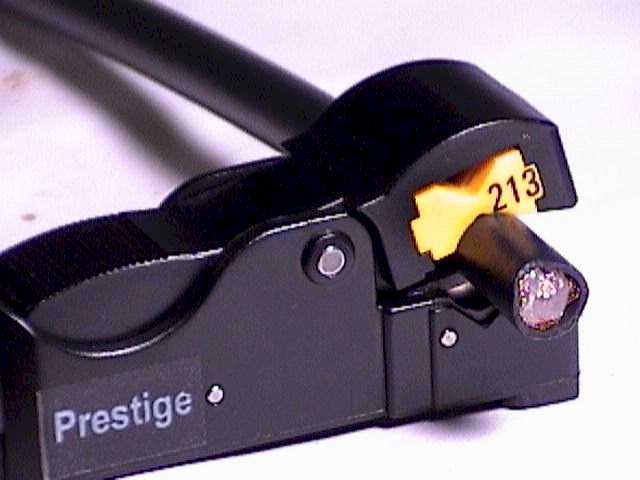
The process begins by cutting the cable to expose an end. The stripper is placed over the cable, with about an inch of cable between the stripper and the end. See the left picture below. You must put the stripper on the coax in the correct direction. That is, the blade settings determine which side of the stripper is nearest to the end. Be sure that this side is towards the cut end of the cable. Now comes a very important point. When rotating the stripper around the cable, be sure to rotate it in a clockwise direction, when looking at the cable from the exposed end. This is important for several reasons. First, this direction causes the blades to cut from back to front. This tends to keep the cable within the stripper. If you rotate in the other direction, there is a greater tendency for the cable to want to walk out of the stripper jaws. This is especially true as the blades become more and more dull, and cut with more and more friction. The second reason is that this clockwise direction is the same direction that will be used to install the PL-259 when it is screwed onto the end of the cable.

In the ideal world, the braid would be cut cleanly without being moved. The truth is, however, that the act of running the stripper around the cable causes the braid to twist around the center insulator as well as be cut. You want this twist to be in the same direction as the PL-259 threads. If you run the stripper in the other direction, the braid will want to untwist when you are screwing on the PL-259, and this just makes an unnecessary problem. If you look closely at the middle picture below, you can see how the very end of the braid is twisted to run around the center insulator. This is just an unavoidable side-effect of the process of turning the stripper around the coax. It really is not an issue, unless you go in the wrong direction.

Knowing how many times to rotate the stripper is also an art. It is possible to rotate it too few, or too many times. My own experience is that I turn it so long as I can hear the sound of the braid being cut. Yes, this is a very distinctive sound. It usually takes about 5 to 8 turns. A three blade stripper will take more turns than a two blade stripper. Let's remember what's going on here. A set of blades are pressing against a cable by the force of a spring. As the stripper rotates, the blades start to penetrate  into the cable. All of the blades need to cut through the one or more layers of different material types. If you do not turn the stripper enough, you will not make a deep enough cut. If you turn it too many times, you may cut deeper than you want. If you consistently are cutting too deep on all of the blades, then you have to readjust the stripper to lower all of the blades together. I mean lower the blades in the stripper so that they penetrate less into the cable.

Positioning the Stripper Stripped and Ready Gripped and Ready

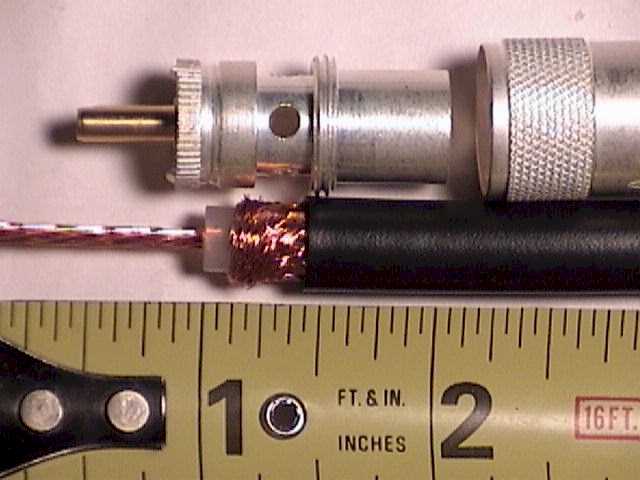
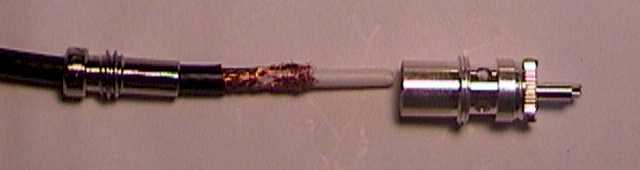
The middle picture shows the end of the cable after being stripped. It took only a few seconds to go from the left picture to the middle picture. The stripper does a great job, very quickly. If you use a stripper to prepare the cable, the blade to blade side spacing, which is not adjustable, will determine the length of each exposed section. As you can see in the middle picture, the length of the center insulator   from it's end to the start of the braid is approximately 1/8 of an inch. The exposed braid section is approximately 5/16 of an inch. These dimensions match the typical instructions given in sources such as the ARRL Handbook. The center conductor can be any length, so long as it is longer than the PL-259 center pin barrel.

The middle picture also shows the prepared coax next to a PL-259 plug.   The center conductor is more than long enough to extend out of the end of the center pin barrel. The center insulator can seat right against the insulator in the plug. The exposed braid is held back from the end (to discourage electrical shorting), but is yet visible through the holes in the barrel of the plug. Finally, the coax jacket can fully thread into the plug, providing a strong grip on the cable, as well as moisture protection.

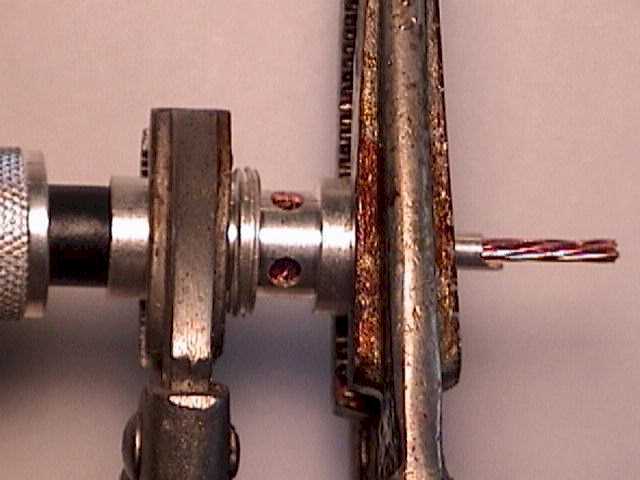
The next step is to screw the PL-259 onto the cable. Prior to this step, be sure that all of the fine braid wires are not touching the center conductor. This may sound rather obvious, but some of the braid wires are very fine, almost to the point of hair. All it takes to cause trouble  is one stray braid wire, that is not dressed with all of the rest, shorting out to the center conductor. Screwing the PL-259 onto the cable can take some muscle. Usually, the problem is that it's hard to grip the small connector and turn it onto the cable. Here's where I start to employ the vise grips. I use my larger pair to grab the connector and use it as a big level arm to aid in screwing the connector onto the cable. Do not put too much force on the PL-259. They are relatively fragile, and I have no doubt that overly aggressive vise grips could bend them out of round, which would cause no end of trouble. Since the PL-259 and the vise grips are both usually knurled, you can make a firm grip with very little pressure. Show your manliness in other ways.

Oh, by the way - before you screw on the PL-259, please make sure that you first put the outer sleeve onto the cable. I think that everybody has, sooner or later, attached a connector then discovered that the outer sleeve is sitting on the desk. This leads to both a laugh and a tear, and is not a suggested step.  Be sure that the outer sleeve is put on in the correct direction. That little variation seems to provide less laughter, and far more tears.

Next, be sure that the PL-259 is completely seated on the cable. As you get closer to this goal, you will see the center insulator then the braid go past the solder holes in the barrel. You should be able to tell that the connector is completely seated by a change in the turning resistance - it should become impossible to screw the connector on any further. Again, this is a step that should be done with moderation.   If you tighten the PL-259 too much on the cable you could short out the cable, or, strip the threads formed (cut) in the coax jacket.

The right picture above shows the cable, with a PL-259 screwed onto its end. The outer sleeve is also already on the cable, and even faces the right direction. Here's where I use the pair of vise grips to grab the connector on each side of the solder holes. This arrangement holds the cable in a horizontal position, which is a convenient place for soldering. It also provides a good heat sink in the critical areas of the cable jacket and the center pin insulator. Neither vise grip is too tight. They grab the connector only enough to hold it, not enough to deform it.

Now when I grip the PL-259, I orient it so that two of the four solder holes are facing up. At this point, all we have to do is to solder the center pin, then the four holes in the barrel, and we are done. I do this in two steps. In the first step, I solder the center pin, then the two barrel holes that are facing up. After the end cools down, and I let it cool for several minutes so that I don't risk creating a cold-solder joint, I rotate the cable 180 degrees so that I can solder the last two barrel holes.

Before I solder, however, I use my Ohm meter to verify that the cable is not shorted. If you read a short (0 Ohms), it might not be your connector installation job. It may be true that the opposite end of the cable is providing the short. I have seen cases where the opposite end of the cable has a rough cut - so rough that the braid touches the center conductor. But if you do find a short in your connector, you still can take the end apart and fix it before applying solder. Personally, once I put a plug on the end of the cable, I don't try to fix the end if there is a problem. I just remove the plug, recut the end, and start over with the coax stripper. Another situation which may come up is that the opposite end of the cable is shunted by an inductor. This could happen if the cable directly connects to the base of a mobile antenna, where the inductor is part of an impedance matching network. In that case, the cable will appear shorted for direct current (DC), even though nothing is wrong. Don't falsely blame your connector when the issue is at the other end of the cable. Assuming that the opposite end of the cable is open, the connector end should measure an infinite impedance.

Once I determine that the cable is not shorted, I solder the center pin. I apply the torch flame to the end of the barrel, where I can heat up both the barrel and the center conductor. The usual rule here is to heat the work, not the solder. After perhaps 5 seconds, I can touch the solder to the end of the barrel and it will flow. I try not to get solder on the outside of the barrel. Usually, there is such strong capillary action that touching the solder to the center conductor near the end of the barrel will cause the solder to flow up into the barrel. Don't apply too much solder. In the extreme, it will flow up the entire length of the barrel and possibly short out the braid.  Certainly apply enough solder so that the end of the barrel is sealed.

After soldering the center conductor, I again check with the Ohm meter, and make sure that the connector is not shorted. Once the center pin is cool, the excess center conductor can be trimmer off with a sharp diagonal pliers.

My next step is to use the torch to heat the PL-259 barrel right between the top two holes. This should be the top of the barrel, if you oriented it as I suggested. After perhaps 10 seconds, the solder will flow into both top holes. The goal here is make sure that there is enough heat and solder to make a strong connection, that the holes are completely filled with solder (no visible braid), but that there is not so much heat and solder that the center insulator melts, potentially shorting the cable. Another potential problem with using too much solder is that it flows into the threads on the barrel, or that it hangs down from the barrel in a big blob. Both of these situations should be avoided.

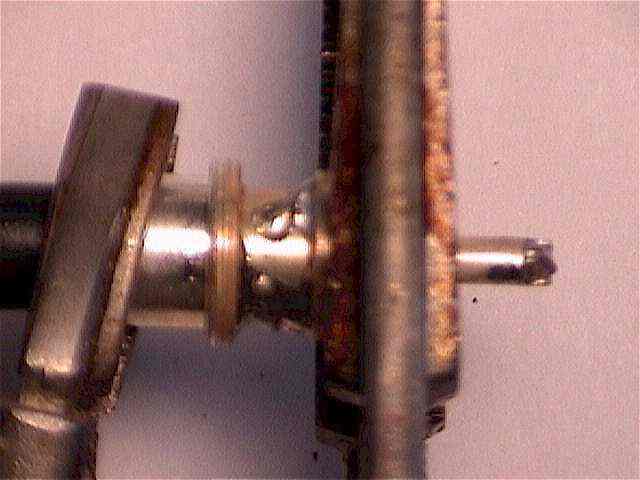
After the connector cools down, I again use the Ohm meter to check that the cable is not shorted. Here is a picture of the connector after soldering the center conductor, and the top two holes.

Soldered Center Conductor and Top Two Holes

The holes have been completely filled with solder, providing protection against moisture getting into the end of the cable. When the cable is cool, I release the vise grips and rotate the cable 180 degrees so that the remaining two holes are pointing up. Those hole are soldered, and a final Ohm meter check guarantees that the cable is not shorted. Even with the vise grips acting as heat sinks, the connector will remain quite hot for several minutes. Please don't burn your fingers grabbing a hot plug.


Some installation procedures suggest tinning the braid and/or center conductor before installation. I do not do that step. I find that I have no problems making strong solder joints, and tinning can cause big trouble if it adds enough solder so that the center conductor no longer fits into the barrel, or if the braid no longer fits within the PL-259 body. I do not aim the torch directly at a hole, but between the holes. The only purpose of the holes (in my approach) is to provide a place to introduce the solder. If you are using sufficient heat, capillary action will suck the solder into the hole, and into the region between the holes. The goal is to have the braid soldered to the plug around the entire circumference of the coax. It is not just 4 dots of solder in the holes. Tinning the entire braid will improve the chances of accomplishing this. Whatever you do, aim for a soldered connection around the entire braid, not just dots at the holes.

In recent (November, 2001) issues of QST magazine, I've noticed that Cable X-Perts installs a piece of heat-shrink tubing over the back end of their ready-made coaxial cable assemblies. This would provide additional protection against moisture infiltration through the back of the connector. While I have never seen the need for this added protection, it certainly can't hurt.

Adapters

When using an adapter, the procedure is very similar. During the preparation phase, it is necessary to expose more braid. This braid is folded back on the adapter before the adapter is screwed into the PL-259.

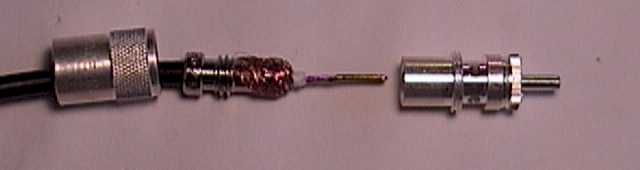
Thin Coax with Adapter Braid folded back on the Adapter Adapter installed in PL-259

The left picture shows the adapter on the coax. The exposed braid has been extended to provide enough length so that when it is folded back onto the adapter, the braid covers the adapter all the way down to the threads. Do not let the braid slop over the threads, however, since it will be impossible to screw the adapter into the PL-259 if there is any braid on the threads.

The middle picture shows the braid folded back on the adapter. In addition, the center conductor has been stripped back, with a small amount of center insulator separating the braid from the center conductor.

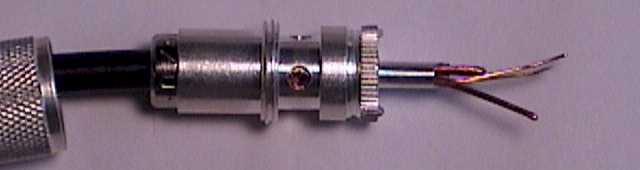
The right picture shows the adapter installed in the PL-259, before soldering. The braid is visible through the holes in the PL-259 body. If you examine the end of the center pin barrel, you will notice that I've taken some folded over solid wire and inserted it into the barrel, next to the center conductor. In some cases, the center wire of the thinner coax is so much smaller than the center pin barrel that the only material connecting the two might be the solder itself. This is an undesirable condition, as solder is really meant to provide mechanical support, not an electrical connection. So, the hookup wire helps fill the large volume of the pin, and insures a positive metal to metal contact between the center conductor and the barrel. When the barrel is properly heated, the solder will flow into the barrel, and create a closed and mechanically rigid space.

At this point in the process the adapter installation merges with the normal installation, which is to say that you have to solder the center pin, then the four holes, and then you are done.


From HCARC..


Soldering PL-259 Coax Connectors


Introduction:


            My first experience with the PL-259 coaxial connecter came into my life when I was in my teens. Like so many others, my two way radio experience was generated through contact with the use of "Citizens Band" radio back in the early 60's. I remember soldering PL-259 connectors onto RG-8U type coax but for some reason they never quite turned out looking like the pictures shown in the instruction manuals. Then one day while I was visiting a friend and HAM at the Navy's instrument calibration lab in Trenton, NJ, I noticed he was assembling PL-259 connectors onto RG-213U cable. I was amazed at how precise he was in his installation and how he made up these cables with ease. As we talked he reveled how at one point in his life with the US Air Force he sat in a small shack at the end of a runway making up coaxial cables for radio navigational systems. He also instructed me in the method he used which I will relay to you here. Over the years I've read all the pro's and con's of several methods and how the "Amphenol" method is the only correct way to install the PL-259 connectors. I've also been told that using a soldering gun instead of an iron is taboo. All I can say is that this is the method I use and I'm going to let you decide on the best method you want to use.


Tools that I use:


·       Utility knife

·       1/4 " square, triangular or flat file (without handle)

·       Small tubing cutter (nylon preferred)

·       Common pliers

·       Wire cutters

·       Soldering rosin (liquid preferred)

·       Weller 240/260 watt soldering gun (or suitable iron)

·       A good quality 60/40 solder

·       Volt-ohm meter

·       Petroleum jelly ell or other light lubricant

·       Denatured alcohol (rubbing alcohol)

·       Paper towel or rag

A word about connectors:


            There are a lot of connectors on the market. Some connectors are very well made and some are pure junk. I prefer to use connectors that don't have a bright shiny finished on them however a Nichol plated shell is fine. These tend to be much more difficult to solder to.


A word about coax cable:


            The method described here is intended to be used with RG-8, RG-213 type coax constructed with a solid insulator. It is not recommended to be used with coax constructed with foam type insulation. While there are many coax cables that are 1/2 inch in outside diameter, the true size of the cables that interface directly to PL-259 plugs is 0.405 inches. These instructions will not cover the use of reducers required for adapting the PL-259 to be used with coax such as RG-8X, RG-58 or RG-59.


The Process:


  • Start with preparing the PL-259.
  • Remove the shell from the plug and set aside.
  • Using the handle end of the file insert the tip into each solder hole on the plug and scrape the edge to remove any debris or plating. You should see bare brass.
  • Next lay the file flat into the area with the holes and lightly remove any burs created from cleaning out the holes. At this time you may want to remove the plating finish around the holes exposing the brass material.


  • Next let's move to the coax and prepare it for accepting the connector.
  • Remove about 2 inches of the coax outer covering known as the jacket. Do this with a sharp utility knife making sure not to nick the wire braid below it. The best method I've found using a utility knife is to score the jacket then bend the coax slightly. This will allow the scored area to split lessening the chances of nicking the braid below it. This may take a little patience at first but with practice it will become easier. If you nick the braid, cut off the coax and start over. Remember, RF travels on the outside of this braid too. By the way, there are special coax cutters manufactured specifically for this purpose but they are in the $50 to $100 price range. The choice is yours.
  • Apply one or two drops of rosin on the newly exposed braid close to the jacket. Use the rosin sparingly and don't over do it. A little goes a long way. The purpose of this step is to allow the solder used in the next step to flow quickly lessening the heat exposure time when applying the solder.
  • Using your soldering gun or iron, apply just enough solder to wick onto the braid from the jacket toward the end of the coax covering about ½ to ¾ inch all the way around the diameter of the braid.
  • Let the solder and coax cool.
  • Using the tubing cutter, position the outer edge of the tubing cutter housing against the end of the coax jacket. This should position the cutting wheel of the tubing cutter the proper distance away from the end of the coax jacket allowing just enough tinned braid to remain after cutting. Continue adjusting the cutter deeper as you rotate the cutter. This will cut through the coax braid and dielectric material. Continue until you have run out of adjustment with the tubing cutter wheel.
  • Remove the tubing cutter from the coax. You will notice that the cutting wheel will most likely not reach the center conductor of the coax.
  • Take the utility knife and gently cut into the cut the tubing cutter made. Cut into the dielectric carefully making sure you do not nick the center conductor. If you nick the center conductor, cut off your work and start over.
  • Once you have cut close to the center conductor you can pull on the scrap end of the coax removing the excess braid, dielectric material exposing the center conductor. This may have to be accomplished with some force or the use of pliers on the scrap end. A slight twisting motion in the natural twist of the center conductor while removing the scrap may also help.
  • Now you should have the coax with about 3/8" tinned section exposed along with about 1 ½" of exposed center conductor. You are now ready to install the PL-259 connector.
  • Place the shell of the connector on the coax in the proper direction. (The threaded end facing the end of the coax you just prepared). DO NOT FORGET THIS STEP…!!!
  • Apply a very small amount of lubricant on the jacket. (cover about ¼ inch in length and all the way around the end of the jacket) This will help lubricate the plug as it screws over the jacket in the next step.
  • Place the plug of the PL-259 on the end of the coax and screw the plug on until it bottoms onto the coax. At this point you may want to back the plug off the coax about 1/8 turn. This will give the coax a little gap between the dielectric and the insulator inside the plug.
  • Looking through the holes in the connector plug you should see the tinned braid. Apply enough solder into each hole to ensure a good electrical connection. Don't get carried away with the heat from the soldering gun or iron. Also ensure that all holes are completely sealed with solder to help prevent water from getting into the holes.
  • At this point you may want to lightly try to turn the plug on the coax. If the plug turns it hasn't been soldered properly and additional solder needs to be added to each hole.
  • Next check for continuity (a short) between the coax center conductor that should be protruding out of the connector pin and the body of the connector plug. You are checking for no continuity (an open) between these two points. I've deliberately not soldered the center pin prior to making this first check. This is so it will be easier to remove the connector if you find a short at this time.
  • Next check for continuity between the body of the plug and the shield at the opposite end of the coax if possible. You should have a good electrical connection.
  • If all is well, than solder the center connecter pin to the center conductor of the coax.
  • Clip off the excess center conductor at the tip of the connector pin and ensure you have a good solder connection. Add a little more solder to the tip.
  • Check for a short between the center pin and the body of the plug of the connector. If there is continuity at these two points then you have a shorted plug and you will have to start over. If you wait to make these checks after you have installed both connectors, you will not know which end has the bad connection. You will have a 50/50 chance of being correct in your guess as to which one is bad so test each connector as you install them.
  • After all the connectors have been installed and checked for proper continuity, clean off the excess rosin with the alcohol and screw the shells onto the connector plugs.


  Remove about 2" of the jacket.                         Tin about ¾" close to the jacket.


  Place the tubing cutter against the jacket.          Cut into the tinned braid/dielectric and                  

                                                                           remove.


Install the shell then screw the plug on and      After checking continuity and plug security;

solder the plug. cut off excess center conductor and cut the tip.

Well these are two great articles, practice makes perfect, I use to really screw them up but being in the business to have to solder ends on I did get pretty good..hope you enjoy and good soldering !!

**********************************************************************************************************************************************

Here is a good article on the UHF Connector...

http://en.wikipedia.org/wiki/UHF_connector


***************************************************************************************


Chip Implants !


Real or Fiction, Do we know the real story ?


" . . . and cause that as many as would not worship the image of the beast should be killed. And he causeth all, both small and great, rich and poor, free and bond, to receive a mark in their right hand, or in their foreheads: and that no man might buy or sell, save he that had the mark, or the name of the beast, or the number of his name."

-- Revelation 13:15-17


Some links for your information...
http://www.greaterthings.com/News/Chip_Implants/index.html#Microchips
&
http://www.antichips.com/
&
http://noverichipinside.com/
note the above link has several categories about chip implants !!
Worth reading more on this, our animals already have them in most, and some humans have, many pages of information , can be found on the internet, just look and research .....

*****************************************************************************************************************************************************
 

White House Names Ham as New Cybersecurity Coordinator

W7HAS_Obama
President Barack Obama greets his new White House Cyber Security Chief Howard A. Schmidt in the Cross Hall of the White House. December 17, 2009. [Lawrence Jackson, official White House photo]

On Tuesday, December 22, President Barack Obama named Howard A. Schmidt, W7HAS, as the new White House Cybersecurity Coordinator. According to the White House, Schmidt -- an ARRL member -- is one of the world's leading authorities on computer security, with some 40 years of experience in government, business and law enforcement and "will have regular access to the President and serve as a key member of his National Security Staff. He will also work closely with his economic team to ensure that our cybersecurity efforts keep the Nation secure and prosperous."

In a 2003 interview with The New Atlantis, Schmidt described cybersecurity as "the realization that computer systems affect our basic needs on a daily basis. Electricity, water, telephone -- these things are all run by computers, and my job is to work with owners and operators and government agencies to make sure that they continue to function properly and are not disrupted because of security events that then, in turn, affect our daily lives."

Schmidt told the ARRL that he credits Amateur Radio with getting him involved with technology: "In high school, one of my friends was a ham and he got me interested in shortwave radio, which in turn got me into building shortwave radios and equipment, many from Heathkit. As I got older, I took courses from NRI and Bell and Howell in electronics and built a number of projects, preparing me for my first ham radio ticket. I love technology, and it was Amateur Radio that caused me to build my first computer -- a Sinclair ZX-80 to use for EME calculations. I studied all about the OSCAR systems and would build equipment to monitor when they would pass within range of Arizona. Building these computers to support my ham radio hobby gave me the technical skills that I need to not only start doing computer crime investigations and work on the early stages of computer forensics, in turn enabling me to start working on cybersecurity issues."

Schmidt is no stranger to the White House -- he served as a cyber-adviser in President George W. Bush's White House. After the 9/11 attacks, President Bush appointed Schmidt as the Vice Chairman of the President's Critical Infrastructure Protection Board and as the Special Adviser for Cyberspace Security for the White House. While at the White House, he assisted in the creation of the US National Strategy to Secure Cyberspace, becoming Chairman in January 2003. In May 2003, Schmidt retired from the White House after 31 years of public service in local and federal government.

Schmidt as a Ham

Schmidt has been an Amateur Radio operator for more than 30 years. "I was first licensed in the late 1970s as a Technician class licensee with the call sign WB7NUV," he told the ARRL. "I did a lot on 2 meters, 70 cm and on Packet. The TAPR group out of Tucson was real inspiration to me as I found the work they were doing absolutely wonderful. I started as a part of the Arizona Repeater Association (ARA) and lived for our annual hamfest at Ft Tuthill in Flagstaff."

Back in the 1980s, Schmidt told the ARRL that he tried moonbounce and had "a full shack of RTTY machines -- Teletype Corporation models 15 and 19 and even a model 21. I would spend weekends printing reams of pictures from Ricky, W0CKY, and all of the great TTY pictures he would transmit. I still have my Collins KWM 2A, 312B station console and accessories. While I have not used it for years, it is one of my treasured possessions. Through the years, I had about every type of HF radio made and even have my Collins R-388 and R-390 in a 19 inch rack. I will never forget the day we were able to talk to Southern California on a 2 meter handheld with the repeaters we had from Central Ariz. During the '100 year flood' in Arizona, the community of Rainbow Valley was essentially cut off from the rest of the state to the north when a bridge and power lines were washed away. Using ham radio equipment, we were able to coordinate moving in food, water, medical supplies and generators from the Air Force base I was working at (then Gila Bend Air Force Auxiliary Field) and work with the county sheriff's office to coordinate support."

Schmidt said that as with many other things, his love for Amateur Radio took a back seat to work, family and life in general: "While I got rid of all of my RTTY equipment back in the early 90's, I have continued to follow all of the great advances of ham radio." He said that only just recently, he got back into the hobby after what he called "an administrative error."

"Someone with a call very similar to mine upgraded to Extra class and when the form was sent to FCC, they mistyped one letter and it was my call that was submitted," he explained. "You can imagine my surprise when I received my Extra class license and new call in the mail. When I tried to find out what happened I was told (wrongly) that I was probably 'grandfathered.' I went out and bought an all band/all mode rig, antennas, power supplies, batteries -- everything I needed to outfit my shack. When all was said and done, we got the error fixed, but by that time, I was hooked on Amateur Radio all over again. I am now in the process of doing a room addition to be my new ham shack! I rejoined ARRL and now have room full of new gear waiting for the remodel to be done. Thanks to what I learned from the many hams on Web sites, I even built in PVC pipes through the walls to run my antennas."

Schmidt's Rise to Cybersecurity Czar

Schmidt began his government service in 1967 -- starting with a tour in the US Air Force -- both in active duty and in the civil service. After leaving the Air Force in 1983, he joined the Chandler (Arizona) Police Department, serving on the SWAT team and the Organized Crime and Drug Enforcement Unit; he formed and led the Special Enforcement Team. In 11 years as a local first responder he dealt with numerous issues surrounding emergency response to local incidents. While on the police force, he was instrumental in selecting, designing and the operation of interoperable communications and a public safety response system. Schmidt left the police department in 1994 to join the FBI at the National Drug Intelligence Center to head up the Computer Exploitation Team.

Schmidt went on to become a Supervisory Special Agent and Director of the Air Force Office of Special Investigations' (AFOSI) Computer Forensics Lab and Computer Crime and Information Warfare Division. In 1996, while serving in that position, he established the first dedicated computer forensics lab in the government, which was the basis for the formation of the Defense Computer Forensic Laboratory (DCFL). In 1997, Schmidt joined Microsoft as the Director of Information Security, Chief Information Security Officer (CISO) and Chief Security Officer (CSO), leaving in 2001 to join the White House. When he retired from government service in May 2003, he joined the online auction site eBay as their Vice President and Chief Information Security Officer and Chief Security Strategist.

Throughout his industry career, Schmidt has served as a reservist in the National Guard and Army. He served in the Arizona Air National Guard as computer communications specialist from 1989-1998, then transferred to the US Army Reserves as a Special Agent in the Criminal Investigation Division where he continues to serve with the Computer Crime Investigations Unit at CID HQ. He has testified as an expert witness in federal and military courts in the areas of computer crime, computer forensics and Internet crime.

After Schmidt retired from eBay, he started his own consulting firm, R&H Security Consulting. In September 2008, he took over as President and CEO of Information Security Forum Ltd; he remains CEO until he begins his White House appointment in January 2010. He is also a board member of the Finnish security company Codenomicon, International President of the Information Systems Security Association and board member of the International Information Systems Security Certification Consortium, commonly known as (ISC). In October 2008, he was named one of the 50 most influential people in business IT by the readers and editors of Baseline Magazine.

Schmidt serves on the Executive Committee of the Information Technology Sector Coordination Council. He is a member of the High Technology Crime Investigation Association, the American Academy of Forensic Sciences and the International Association of Chiefs of Police. He has testified before congressional committees on computer security and cyber crime and has been featured on BBC, ABC, CNN, CNBC and Fox TV discussing cybersecurity, investigations and technology. He is the author of Patrolling Cyberspace, Lessons Learned from a Lifetime in Data Security and a contributor to The Black Book on Corporate Security.

Now that Schmidt has rediscovered how much fun Amateur Radio can be, he has no plans to let his enjoyment pass him by again. "I have my multi-band handheld transceiver next to my suitcase to take back to DC with me," he told the ARRL. "I hope to set up a station once I get settled. I do not plan on letting any more years slip by and not enjoying this great hobby."

*********************************************************************************************************************************


No Tuner Antenna

http://www.antennex.com/preview/notuner.htm

From W8WWV.. Antenna Page..

http://www.seed-solutions.com/gregordy/Amateur%20Radio/Experimentation/IVee80.htm

Vertical antenna's and info.....

http://www.ztechnology.com/Measurement_Antenna_Selection.html

Plan Facts about verticals ...

http://www.arrl.org/tis/info/multibandvert.html

Why antenna's radiate .......

http://www.arrl.org/tis/info/whyantradiates.html

The Antenna Elmer ...

http://www.qsl.net/w4sat/antenna.htm

From Walter on Antenna Hanging  !!  No Need To Climb Anymore .......
Slingshot method for hanging SkyWires.


Guys,

In my youth (19 years old), fresh out of Marine Corps Boot Camp, I
would climb to the tops of trees like a monkey, while friends on the
ground would yell "that's high enough!!" to put up Owl
Nesting
boxes, etc.. What they didn't know was it was much easier that
most
of the stuff the Corps had me doing.

That was then and this is now. Now Walter no longer leaves the ground
unless I have a boarding pass, and a coach ticket.

After reading a few articles I decided to try the slingshot method of
hanging a wire antenna.

Its Pretty easy.

You need the following items.

A fishing pole, a dozen 1 oz. Lead egg sinkers, a good Crossman or
Wrist-Rocket slingshot, a large spool of Trout Line, Large Nails,
a hammer, and a Fishing pole holder, if you can't find someone
to
help.

I've seen ads in radio magazines for a slingshot-fishing reel
combo,
for $100. If you have $100 to blow, take you wife out to a fancy
restaurant. I believe it's a much better investment that this.
The
slingshot, and a fishing rod and reel will set you back about $30..

I use trout line because it is very strong, and given its to be used
in water, its waterproof, and seems to hold up very well, and is
cheap. But if someone knows of another rope that works better, please
let me know.

You can find all of this at your local bait and tackle store. I pay
about 20 cents for each egg sinker, I use egg sinkers because they
are about as aerodynamic as fishing weights get, and because the
shape doesn't allow them to get hung up in the tree branches as
much
as others do, but it still happens.

I have heard of people using a Bow and Arrow. I can see some
advantage to this, but I think the risks outweigh the benefits. With
a 1 oz. Egg sinker, you have to be careful it doesn't come down
on a
parked car's windshield, or dent the hood. With an Arrow, it
could
put a hole in someone's roof, or worse, if you neighbor or his
kids
are outside, they could end up impaled and looking like Gregory Peck
in the last scene of the movie "The Omen". We don't want
that…

When shooting the egg sinker, you want to be on the "Antenna
side"
of the tree.

Take the pole holder, and place it in the ground at an angle, facing
the target tree. Put the fishing pole in the holder.

I have read that if you paint the egg sinkers blaze orange, you can
see them better when they come down. I haven't tried this, but it
makes sense. Having a florescent fishing line in your fishing reel
helps in locating the downed egg sinker, but is not necessary.

If you are right handed, taking the slingshot in the left hand, and
stand with the fishing pole to the right of you. If left handed, do
the opposite. Place the egg sinker in the sling with the fishing line
coming out of the top, and clear from the rubber bands.

Make sure not to stand too close to the tree, you want the egg sinker
to clear the tree, and fall on the far side, if you are too close,
you will be shooting at too high an angle and the egg sinker
won't
fall on the far side, but on the shooting side.

Shoot the egg sinker and pay attention to the direction of where you
shoot, and see if you can judge where it should have landed before
you walk over to the far side of the tree.

Then go find it. You may find that you need to take the fishing pole
and "play" with the line a bit to get the egg sinker to fall
down to
ground level from the higher branches.

If it gets hung up, you will just have to reel it back and start
over. I have about a 50/50 success rate.

Once I find the egg sinker, I cut it off, then tie the trout line to
it and go back to the fishing pole and reel the trout line back over
the top of the tree.

When the trout line reaches the pole, cut the line, and tie your dog
bone insulator on to it.

Go back and cut the trout line from the trout line spool, and take
two large nails and hammer each of them about half way into the trunk
of the tree. The nails should be about a foot or so apart and angled
away from each other forming a cleat.

I like to hammer the nails high enough that some kids don't come
along and decide to undo my work. If this is a real concern, you may
consider using a ladder and nail them higher up on the trunk of the
tree. Plus, the higher up, generally the less visible it is too.

Tie the trout line around one nail.

Repeat these steps on all the trees in your SkyWire system.


Once you run your antenna wire through the dog bone insulator you can
then begin to raise the antenna by taking the slack out of the trout
line. Just begin wrapping the trout line around the both nails in a
loop until the antenna reaches the desired height.

That's about it.


I am currently working on a fuse system that uses a bungee cord, and
counter-weight, so that when bad weather hits, and high winds put too
much pressure on the SkyWire, that the "fuse" will break
causing
about 20 feet of extra trout line to be unleashed, and letting the
SkyWire fall limp, but not letting it break. This would allow you to
easily recover the extra trout line, and put a new "fuse"
back into
the system after the storm passes.

Once I have the dynamics of this worked out, I will post it.
(sometime this fall, I hope)..

Thanks,

Walter
http://groups.yahoo.com/group/SkyWires/

How high should my dipole be ? ......

http://www.qsl.net/aa3rl/ant2.html

Choosing Wire For  A Antenna ...

    One of the most asked questions when it comes to antennas is what kind of
wire should I use. The answer is as varied as the people who put them up.
Over the last 28 years I have used or have seen used every kind of wire used
to make an antenna. Just one disclaimer the information below is referring
to antennas used for listening and NOT transmitting.

Stranded or Solid

I have seen both used with great success. Stranded wire is as a rule (and we
all know rules are made to be broken) easier to work with and can at times
be stronger. Stranded wire is usually more flexible so if you are not putting
out a straight wire or bringing it into a house or apartment it may be superior
to solid core wire. Solid wire is at times (especially with thinner wire) easier
to break.

Coated or Bare

Wire with a coating is called insulated while bare wire in uninsulated. For
antennas I do prefer the coated or insulated wire. The reason for this is that
coated wire can be easier to work with as if it touches something conductive
such as metal it is OK. Bare wire must be kept away from anything
conductive to work properly. If bare wire comes into contact with anything
conductive that material becomes part of the antenna. This can ruin an
antenna's pattern or worse yet a ground system. This latter matter can cause
an antenna to short out or worse yet cause damage to a radio due to static
discharges. The choice would be yours as the coating or insulation will NOT
decrease the signals received. If radio signals can go through your brick wall
the tiny amount of plastic or rubber used to coat the wire will not bother your
reception.

Thickness

The thickness of wire is measured by its gauge. The higher the gauge
number the thinner the wire. I have used wire any where from 24 to 16
gauge over the years. Now the very thin high gauge 24 or 22 wire was used
in pairs to give it some strength. No use putting out an antenna and have the
first gust of wind tear it up. Wire of 18 or 16 gauge is quite good. I often use
lamp cord or light indoor extension cord wire. This is insulated and cheap
to buy at any hardware store. Hey you can be frugal and buy half the wire
you need and split the wires to give you the length you need on a heavier
gauge wire that is twinned like the lamp cord. If you live in areas that are
subject to bad weather especially high winds or ice storms heavier gauge
wire should be used so it can with stand the elements if the antenna is up in
the air.


Copper vs Everything Else

In my humble opinion it matters not which you use. I have used everything
from copper to aluminum to mystery metal over the years. I have never
noticed any difference in the signal strength obtained from different types of
wire. Go with the price on this topic depending on what you can obtain at
your location.

Simple rules to follow:

Once you pick the wire you want make sure you have thought these points
out:
If a wire is going to be left on the ground coated/insulated wire is a must.
If a wire is on snow you can use either as snow in an insulator.
If a wire is up in the air and away from anything conductive you can use
either type.
If up in the air and near or touching anything conductive you must use
coated/insulated wire.
If you live in areas that are subject to bad weather especially high winds or
ice storms heavier gauge wire should be used so it can with stand the
elements.

OK now go out and put up something. Experimenting is half the fun in this
hobby.


TIP 1
I should also mention that I use a good silicone seal on all my connections.
3M makes a very good clear calk, spreads nicely, and really seals out the moisture No moisture, no corrosion.I have taken down antennas that have been up 5 years before a storm got them,
and the connections were just as new and shiny as the day I put them up.
Everything else was weathered, but not my connections.
Just thought I would pass it on for trouble free connections. .
KC0VEA


TIP 2
Noting your comment about using any type of wire, I have made an excellent long-wire antenna with the use of a 30 meter
plastic coated steal washing lineand they had them in different (bright) colours...
It has great strength, is weather proof and only cost me £1.99 from my local market in Birmingham England UK.
John Chown


How USA wire gauge correspond to metric wire measurements.

Wire Dia. Dia.
gauge mm. in.
----- ---- ----
0 8.251 .3249
1 7.348 .2893
2 6.544 .2576
3 5.827 .2294
4 5.189 .2043
5 4.621 .1819
6 4.116 .1620
7 3.665 .1443
8 3.264 .1288
9 2.906 .1144
10 2.588 .1019
11 2.305 .0907
12 2.053 .0808
13 1.828 .0720
14 1.628 .0641
15 1.450 .0571
16 1.291 .0508
17 1.150 .0543
18 1.024 .0403
19 .9116 .0359
20 .8118 .0320


Life span of an antenna...one man's joking opinion:


Well, generally it depends on hours spent listening.

The antenna converts electro-magnetic energy into electrical energy, which is
basically electrons moving into your radio.
There are only so many electrons in each inch of copper wire, so when they've
been sent downstream into your radio, the wire will become "ionized" and
deteriorate and probably fall down. This explains why, when you come home one
day, your antenna is on the ground (see below).

What happens to all those electrons, you ask. Well, they migrate into your
radio and accumulate. In older tube radios, there was a "grid leak" resistor
circuit which allowed the electrons to fall on the ground. Now you can't see
them, but they're there. As more pile up, they slide into your back yard.

Tube radios, because of the "grid leak" last a lot longer than solid state
radios, which stop working when enough electrons have piled up inside to short
it out.

Now those electrons in your back yard want to get back into the copper wire, so
they "pull" the antenna down to be re-united with it. Since the antenna is
high, and they're on the ground, this attraction is not strong, but on a windy
day, the electrons get lifted from the ground towards the antenna, pulling it
down again. The wind oftens brings in free electrons from your neighbor's homes
(from TVs, etc), so there may be a lot of these things around. If too many
electrons get lifted up all at once, they overload the antenna, causing a heat
mark, or worse getting back into the radio. Now this is why your antenna
usually falls down on windy days.

At least, that's how I understand it.

You can extend the life of your antenna by disconnecting it from your radio
when you're not listening. But overall, 500 to 1000 hours spent listening will
do in a longwire antenna.

It a joke OK!!!
Thanks Amandx for this great article !

Well that's it for this week ,hope the articles have been to your liking and informative...

Don't forget the 2010 - 470 ARG net starting back in Jan, every Thursday
at 7:30 PM on the 145.470.. Happy New Year
Rick, Cathy, Oscar, Honey Bee and Max
God Bless You and God Bless America


Rick Sawaya Sr  N4JTQ
NCS For The 470ARG Net
President of Sevier County Emergency Radio Service,EC For Sevier County, ARES & Skywarn Member
ARRL VE & CE, SCERS Club Call Trustee KJ4HPM, Member OMISS
Cathy Sawaya KI4YPO
Amateur Extra Class
NCS for The Ladies Round Table Net
2005 Spence Mountain Loop
Sevierville,TN 37876
865.429.2422
Monitor 145.470 , 444.300, 146.730, 146.940
HF -3.980, 3.975, 3.983,3.940.5

Want To Help Support The 470 Send All
Donations to the 145.470 send to: Mr.Tim Berry
214 Echodale Rd
Knoxville TN 37920


This electronic message may contain information that is confidential and/or legally privileged. It is intended only for the use of the individual(s) and entity named as recipients in the message. If you are not an intended recipient of this message, please notify the sender immediately and delete the material from any computer; do not deliver, distribute or copy this message, and do not disclose its contents or take any action in reliance on the information it contains. Thank you.